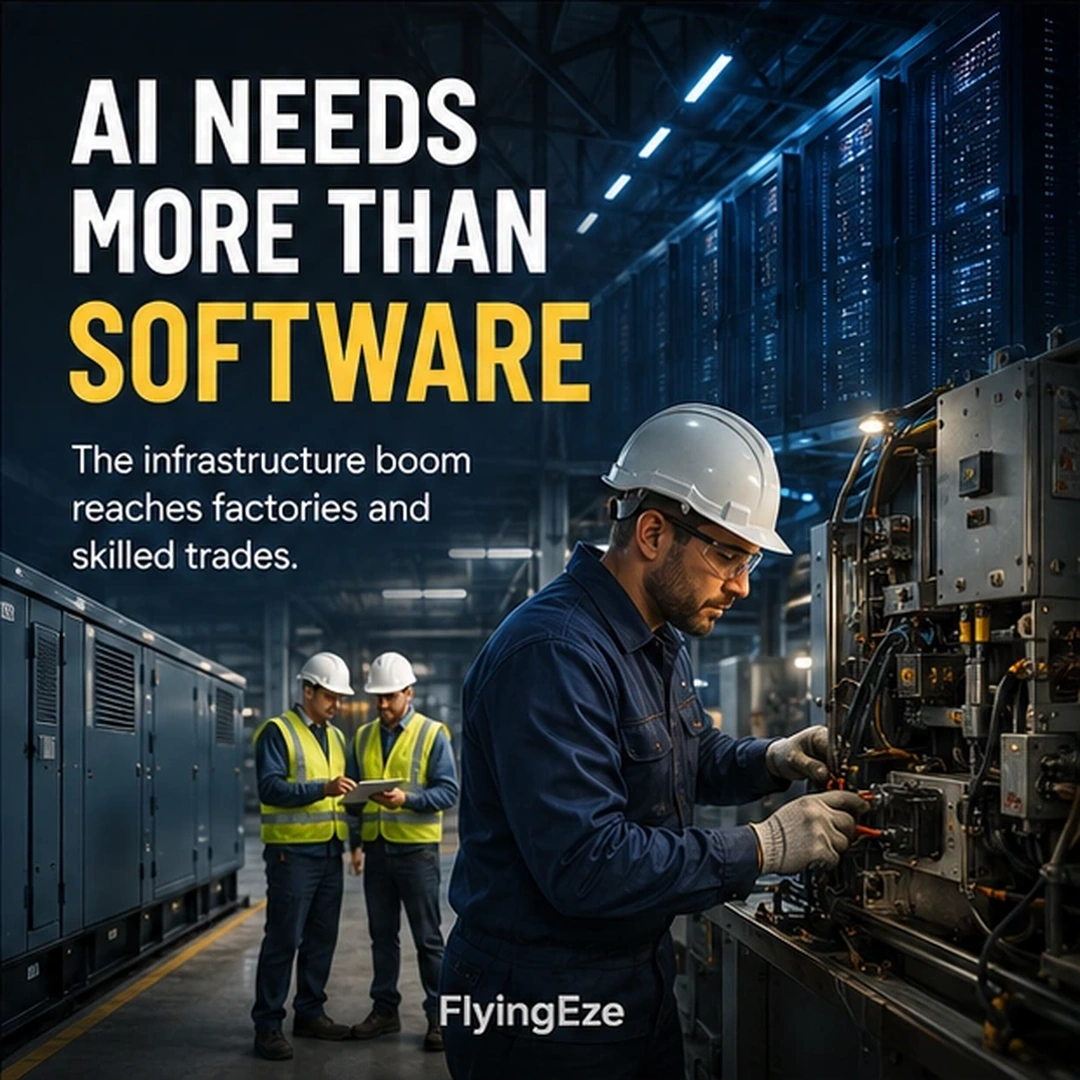
When people think about jobs created by artificial intelligence, the first occupations that come to mind are usually software developers, data scientists, AI researchers and chip engineers.
But the AI boom is creating demand much further away from the computer screen.
Behind every advanced AI model is an enormous amount of physical infrastructure.
AI systems need data centres.
Data centres need electricity.
They need backup generators, cooling equipment, transformers, cables, networking hardware, buildings, roads, construction machinery and people with the skills to install and maintain all of it.
That means some of the economic opportunities created by AI may appear in places that do not initially look like technology businesses at all.
Generac Is One Example
Reuters reported on August 19, 2026, that generator manufacturer Generac is expanding production as demand from data centres grows.
The Wisconsin-based company plans to spend $250 million by the end of 2027 equipping multiple factories to produce larger generators designed for data-centre applications.
Its order backlog for data-centre generators has already reached approximately $1.6 billion, and the company expects to add about 1,000 workers, equivalent to roughly 10% of its workforce.
Generac separately reported in July that its commercial and industrial sales had risen approximately 29% year over year and that it had secured agreements with major hyperscale data-centre customers.
Generac may be known to many consumers for residential backup generators.
AI infrastructure is now helping create an entirely different growth opportunity.
AI Needs Much More Than GPUs
The semiconductor industry receives enormous attention because AI requires powerful processors.
But chips cannot operate on their own.
A modern data centre also requires systems for:
- Electrical distribution
- Backup power
- Cooling
- Networking
- Fire protection
- Physical security
- Water and environmental management
- Buildings and structural systems
- Maintenance and repair
Even those categories have their own supply chains.
Reuters reported that the data-centre boom is increasing demand for manufacturers of cooling systems, electrical transformers and construction machinery, while suppliers of products including wire, pipes, cement and prefabricated metal walls are also benefiting.
Research firm Wood Mackenzie projects that the U.S. electrical-equipment market associated with data centres could grow from around $33 billion in 2025 to $66 billion by 2030.
The AI economy therefore extends far beyond companies developing models.
Digital Technology Still Depends on the Physical World
It is easy to think of artificial intelligence as almost entirely digital.
A user types into an interface.
An answer appears.
The physical machinery behind that interaction is largely invisible.
But somewhere, servers are consuming electricity.
Cooling equipment is removing heat.
Power infrastructure is maintaining reliability.
Fibre connections are moving data.
Technicians are installing equipment.
Factories are producing the components required to make the entire system work.
A useful way to think about it is:
The cloud still has a physical address.
And building that physical infrastructure requires people, materials and businesses.
That Creates Career Opportunities Beyond Coding
This matters for young people thinking about future careers.
“Working in technology” does not necessarily mean becoming a software engineer.
The growth of AI infrastructure may increase demand for people with skills in areas such as:
Electrical engineering
Data centres require enormous amounts of reliable electrical infrastructure.
Electricians
Complex electrical systems have to be installed, inspected, maintained and repaired.
Mechanical and cooling engineering
High-performance computing produces significant heat, making cooling systems essential.
Construction
New data centres require builders, project managers, equipment operators and numerous specialist contractors.
Manufacturing
Generators, transformers, switchgear, cables, server equipment and structural components all have to be manufactured.
Network engineering
Data centres need extremely high-capacity communications infrastructure.
Maintenance and technical services
Once infrastructure is built, somebody must keep it running.
Energy and power systems
Rapid data-centre expansion is creating new challenges for utilities, grid operators and energy developers.
A career connected to AI may therefore involve wires, engines, buildings or cooling systems instead of Python code.
Smaller Suppliers Can Benefit Too
The opportunity is not limited to multinational corporations.
Reuters highlighted Southeastern Hose, a family-owned Georgia manufacturer that traditionally supplied corrugated metal hoses to steel and petrochemical customers.
Demand from data-centre projects has helped the company's revenue triple over five years. It has added 60 employees and now employs about 150 people.
That example illustrates an important business principle.
You do not necessarily have to create the headline technology to benefit from a technological shift.
Sometimes the opportunity is supplying one component required by the companies building it.
Think in Terms of the Supply Chain
When a major technology begins expanding rapidly, entrepreneurs often ask:
“How can I build something with this technology?”
That is one question.
Another is:
“What will everybody building this technology suddenly need more of?”
Those needs can exist several layers away from the final product.
During a major infrastructure expansion, opportunities may appear in:
- Equipment supply
- Installation
- Logistics
- Training
- Maintenance
- Security
- Construction
- Energy
- Recruitment
- Compliance
- Consulting
- Repair
- Waste management
Not every opportunity requires creating a new AI model or raising millions in venture capital.
Some may involve applying an existing trade or business capability to a rapidly growing customer base.
This Pattern Is Not Unique to AI
Major technological shifts frequently create businesses around the technology itself.
The growth of automobiles created demand for much more than car manufacturers.
It supported:
- Petrol stations
- Mechanics
- Roads
- Tyre manufacturers
- Insurance businesses
- Parts suppliers
The expansion of the internet created opportunities beyond website companies.
It increased demand for:
- Data centres
- Fibre networks
- Cybersecurity
- Payment infrastructure
- Cloud computing
- Logistics
AI may follow a similar pattern.
The headline product attracts attention.
The surrounding ecosystem creates additional layers of economic activity.
But Booms Also Carry Risk
There is an important caution.
Rapid infrastructure investment does not guarantee that every supplier will experience permanent growth.
Reuters reports that some manufacturers are already considering what could happen if the data-centre construction boom slows or proves excessive.
Companies making large investments in new factories can be left with unused capacity if demand falls unexpectedly.
Siemens, for example, is investing more than $200 million in new U.S. facilities serving data centres and other industrial customers, while using multi-year customer agreements as one way to reduce some of that risk.
That is another useful lesson for entrepreneurs:
A growing market is an opportunity, not a guarantee.
Demand, competition, capital requirements and long-term sustainability still matter.
AI Is Becoming an Infrastructure Story
The AI industry is often discussed through model releases, benchmarks, chips and software companies.
But as adoption grows, another story is becoming increasingly important.
AI is also becoming an:
energy story
manufacturing story
construction story
engineering story
workforce story
and an infrastructure story.
For young people, that expands the meaning of a technology career.
For entrepreneurs, it expands the range of places worth looking for opportunity.
You may not need to build the next AI model.
You may need to build, install, manufacture, maintain or supply something the AI economy cannot operate without.
Why It Matters
Technology booms rarely create value in only one industry.
AI development is driving investment in computing infrastructure, and that infrastructure requires physical equipment, skilled workers and extensive supply chains.
The larger lesson is useful well beyond AI:
When a major technology grows, look beyond the product itself and examine everything required to make that growth possible.
Sometimes the most interesting opportunity is not building the technology everyone is talking about.
It is supplying what that technology needs to operate.