
AN URGENT travel warning has been issued to unvaccinated Brits, amid an outbreak of a highly contagious infection that strikes victims with a tell-tale “bull neck”.
Australia is grappling with its worst outbreak of in decades, which has resulted in one death.
 Diphtheria is surging in Australia, having caused one death
 British travellers have been urged to make sure their vaccinations are up to date Credit: Alamy
Cases have been rising steadily in the country since late 2025, increasing sharply from February this year.
Now, Brits have been urged to check they’re vaccinated against the illness before travelling to .
Diphtheria is a very contagious bacterial that can affect the nose and throat, or the skin.
It spreads through droplets from coughing or sneezing, or by direct contact with infected skin sores.
Diphtheria can become serious and sometimes fatal, especially in children, if it’s not treated quickly – but there is a highly effective vaccine that prevents it.
The jab is usually given during infancy through the six-in-one vaccine, before being topped up at three and 14 years old.
It comes after the National Pharmacy Association (NPA) warned of falling , which it warned could lead to preventable disease outbreaks.
Uptake of Td/IPV vaccine, known as the three-in-one teenage booster that protects teens from tetanus, diphtheria and polio has fallen by 15 per cent since 2018.
How to protect yourself against diphtheria
Diphtheria is rare in the UK because babies and children have been routinely vaccinated against it since the 1940s.
The 6-in-1 vaccine protects children against six serious illnesses, including diphtheria.
Children are given four doses of the six-in-one vaccine as part of the NHS vaccination schedule.
They are given the vaccine when they are:
- Eight weeks old
- 12 weeks old
- 16 weeks old
- 18 months old (if they were born on or after July 1, 2024)
Children then receive the four-in-one pre-school booster at three years and four months, before they start school.
Kids can have this vaccine up to the age of 10.
Finally, teens also receive protection against diphtheria through the Td/IPV vaccine (also called the three-in-one teenage booster).
The best way to avoid diphtheria while travelling is to be fully vaccinated against it.
If you’re travelling to a part of the world where there may be a risk of diphtheria, you may need a booster vaccination if you were last vaccinated against it more than 10 years ago.
Some parts of the world where there may be a risk include:
- Africa
- South America
- India
- South East Asia
- Eastern Europe
Source: NHS
This leaves over a quarter of 14-16 year olds unprotected, the NPA said.
Australia recorded its first diphtheria death in a decade this week, amidst rising cases of the illness.
The man died in April at Royal Darwin Hospital, but lab tests confirmed on Tuesday that diphtheria was the cause.
An outbreak was formally declared in March, mostly affecting the Northern Territory (NT).
But cases have also cropped up in Western Australia, South Australia and Queensland.
Professor Michael Kidd AO, Australia’s Chief Medical Officer, said in a statement last week: “This is the largest outbreak since national records began in 1991.”
He declared the outbreak a Communicable Disease Incident of National Significance, adding that the country was putting together a nationally coordinated response to tamp down on cases.
Cases are predominantly being spotted among Aboriginal and Torres Strait Islander communities.
The government has ramped up vaccination efforts in areas most at risk and the number of new cases is now falling, health officials said this week.
The last reported diphtheria death was in 2018, according to the national broadcaster ABC.
In the UK, diphtheria outbreaks are very rare, because babies and children have been routinely vaccinated against the illness since the 1940s.
But the Government’s Travel Health Pro website states: “Diphtheria is still a risk for unvaccinated travellers to countries where the uptake of diphtheria containing vaccines is low.
“Vaccination is the most effective way to prevent infection.
“Travellers should ensure they are up to date with their routine vaccines according to the UK routine immunisation schedule.”
Vaccine rates, including for jabs and boosters that protect against diphtheria, have fallen in recent years in the UK.
This has made outbreaks of preventable diseases – such as meningitis and measles – more common, the NPA argued.
Olivier Picard, the organisation’s chair said: “Falling rates of childhood vaccination represent a significant public health challenge and could have tragic consequences if not addressed.
“Without urgent action to tackle a dangerous and growing wave of vaccine hesitancy, we risk seeing more heartbreaking outbreaks of preventable illness that we have already seen in parts of the UK recently.
“Pharmacies stand ready and able to support the NHS tackle this.
“We need reform to an outdated childhood vaccination programme which recent evidence suggests has seen declining levels of uptake, with potentially worrying consequences.”
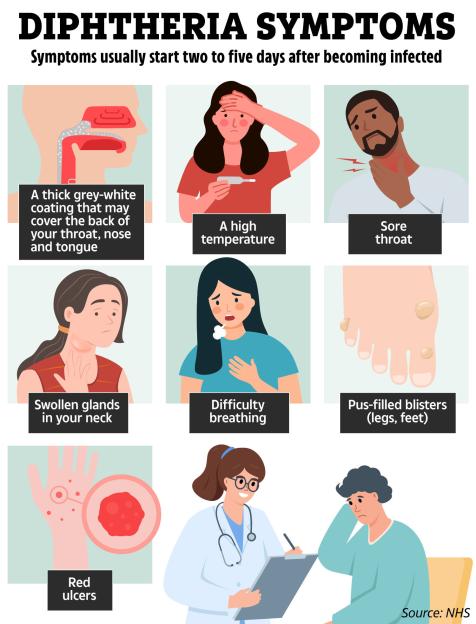
Respiratory diphtheria often starts with fever or chills and a sore throat.
It causes a thick grey-white coating at the back of the throat, nose and tongue, and fever.
More severe cases can lead to a characteristic swollen neck and throat, or “bull neck”.
This can make it hard for the person to breathe properly or swallow.
If the disease affects the skin, it can cause pus-filled blisters on the legs, feet and hands, as well as large ulcers surrounded by red, sore-looking skin.
Health officials last year issued warnings over increasing reports of the illness in Europe and the UK.