ON an infamous stretch of water known as “shark highway”, some surfers are still willing to risk it all to pursue their passion.
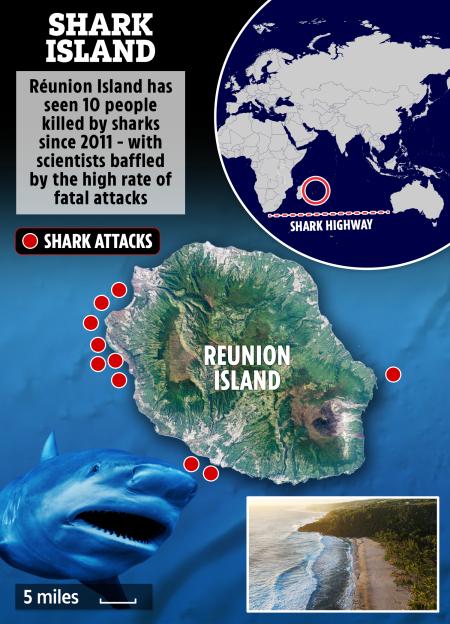
Jorgann Couzinet, 32, is one such daredevil who hails from the paradise island La Reunion – a honeymoon hotspot that has been plagued with the highest rate of shark attacks in the 21st century.
 French champion surfer, Jorgann Couzinet, 32, shares his view of the La Reunion shark attacksCredit: Supplied
 The four-time European champion is working hard to qualify for the 2028 OlympicsCredit: Supplied
 Jorgann learned to surf amongst sharks while growing up on the paradise islandCredit: Supplied
As an athlete who is pushing hard to qualify for the 2028 Los Angeles Olympics, Jorgann has to be willing to accept the risks when training in his homeland.
“I just kiss my girlfriend on the beach and say ‘I love you’, because I don’t know if I’m going to be able to come back,” he told The Sun.
Jorgann’s family relocated to the island – in the western Indian Ocean, located east of Madagascar and southwest of Mauritius – from France when he was just five-years-old, and learnt to surf in the company of the apex predators.
“I have so many memories surfing with friends, and sometimes seeing sharks underneath my board. We were all tripping out.
“I remember seeing big tiger sharks jumping out from the water only 200 metres from us while we were surfing a wave that was super far from the beach.
“We were like ‘What the f*** just happened?’ This thing was so big.
“I was really young, probably 14, so I wasn’t really scared of them because I knew they weren’t really interested in us.”
But a spate of horrific attacks and deaths in the 2010s forced him to return to France as his career was starting.
The gravity of the “la crise requins” – or the crisis – had become so troubling that sweeping swimming and surfing bans were put in place across the island.
Jorgann said: “The shark issue just became really, really bad.
“If you went surfing you would risk your life, but you were also getting fined. It was crazy.”
The four-time European champ still returns to the island during the winter months to soak up the sun, see old friends, and train on the waves where he honed his craft.
And despite the last shark-related incident happening in 2019, blanket bans on surfing still exist.
“They are not putting so much pressure on us because they’ve seen that a lot of people are surfing again.
 The French champion is part of Reunion’s ‘sacrificed youth’Credit: Supplied
 Surfers on the island are normally accompanied by spotters who help spot sharks before they strikeCredit: AFP
 Bull sharks thrive in Réunion’s shallowsCredit: Getty
“So now they let it happen, but we’re still not allowed to go surfing. So if something happens they’re not responsible for it,” he said.
“We just want to be able to surf without getting fined for no reason, because we are already risking our lives for the sport we love.”
Tragically, some lose their lives even if they exercise proper caution.
Such was the case for 13-year-old surfing sensation Elio Canestri, who died at the hands of a bull shark in 2015.
The boy reportedly left a note for his mum before heading out to the beach to let her know he wouldn’t go into the water unless there were dedicated shark spotters.
“Don’t worry, Mum,” he wrote. “I’m going surfing. If there’s no security, I won’t surf.”
Elio was sadly killed in shallow waters, only 15 metres from shore.
His heartbroken father, Giovanni, told French broadcaster RTL that his son had “always been very careful”.
He said: “He was someone who always listened to his parents.
“He analysed danger intelligently, he was a competitor.”
 Surfing prodigy Elio Canestri, 13, was tragically killed while surfing in the shallowsCredit: Unknown
 Tiger sharks kill a third of their attack victims worldwideCredit: Getty
At that point, an extraordinary 16 shark attacks – seven of them fatal – had occurred in just four years on the island.
Giovanni added: “Titi was devoured by his passion.
“Fate decided one day to take him away and he is gone.”
The loss was also particularly harsh on Jorgann, who felt like something of a mentor to the boy.
“He was like a little brother to me,” he said.
“I was there for him. Supporting him. And this [incident] really shocked me.
“I was really sad about the situation because I didn’t know if I was going to lose other close friends.”
In 2013, a 15-year-old girl was killed while snorkelling just metres off shore near Saint Paul on the island’s west coast.
Sarah Roperth’s body was torn in two at the torso, with part of the body dragged to the depths by the shark.
At the time, St. Paul resident Jean-Philippe told French media : “This little girl was not a tourist. Her father has lived on Réunion for a long time and she has swam here since childhood.”
Jorgann counts himself lucky that he has avoided the same tragic end.
 The shark attack victims of the 2010s have become known as the ‘sacrificed youth’Credit: AFP or licensors
 Rescuers and gendarmes carry on a stretcher the body of young bodyboarder, who died following a 2017 shark attackCredit: AFP or licensors
He said: “I was surfing every day, and then one day I was like ‘OK, well, I don’t really feel like surfing.’
“I just felt like the water was moving a lot. Normally I’m always out.
“By the time I was getting home – I lived probably 15 minutes from the beach – I got a message from a friend telling me that someone had been bitten by a shark and died. It was crazy.
“I realised that maybe I was lucky to survive this whole time.”
Jorgann became part of what is known as the “sacrificed youth”, who surfed on the island during a period of 25 recorded attacks, 11 of them resulting in death.
“When I was a teenager, the best surfers in France came from Réunion,” he told Le Monde . “There will be a generational gap because they took too long to act.”
French bodyboarding champion Mathieu Schiller was one of the first who tragically died during that period, succumbing to an attack on September 19, 2011.
His body was never found.
 Bodyboarding champion Mathieu Schiller disappeared from Reunion Island in 2011Credit: Not known clear with Picture Desk
 People take part in a ceremony to pay tribute to late Schiller on September 21, 2011Credit: AFP
 Youths display a surfboard bearing a slogan which translates as “Whose turn next?” after Elio’s deathCredit: AFP
“It was a nightmare,” Jorgann said. “At the time of the first attacks, we felt like we were living through Jaws.”
But the young surfer continued to defiantly pursue his passion and eventually won his first French championship title in 2013 at the age of 20.
It was around this time that he decided to move to mainland France.
On top of the worrying surge in shark attacks throwing La Reunion into chaos, Jorgann felt the move would benefit his career.
“I thought it was the right time to start getting sponsors over there, showing myself a little bit more,” he said.
He funded his passion by taking on odd jobs as a pizza chef and jet-ski instructor before receiving a call up to the French team at the EuroSurf 2015 in Morocco.
The Frenchman saw his career take off after victory in the second division of the World Surf League (QS) in 2017 as sponsored poured in.
Jorgann then skyrocketed to the top of the QS world rankings in 2019 after being crowned European champion for the second time.
The trauma of the “shark crisis” could have easily driven Jorgann away from the sport forever.
Instead, he chose to carry the memory of the “sacrificed youth” with him into every competition.
 Jorgann has gone on to have a successful international careerCredit: Waterwork media and Surfing France
 The Frenchman moved to France to attract sponsorsCredit: Waterwork media and Surfing France
He doesn’t just surf for professional glory; he surfs for Elio, for Mathieu, and for the many others claimed on the “shark highway.”
This haunting history has transformed from a source of fear into a profound source of power.
He said: “Every time I go there [Reunion], I just surf, but I think about them all the time. I just try to share the session with them.”
Jorgann believes it gives him an edge over the competition.
“I’m always going in the water thinking about my friends that I’ve lost. It became one of my strengths.”
“I know I’m not alone. I know I can count on them.
“Sometimes before a competition I’m just looking at the lineup – with big dogs like Kelly Slater – and I’m like, ‘I know they’re going to send me the wave.’
“If I need a score, I know they’re going to help me out.”
World's deadliest shark attack
THE heavy cruiser USS Indianapolis had raced across the Pacific with components of the first atomic bomb.
But two torpedoes in the dead of night destroyed that triumph – sparking the deadliest shark attack in history.
The disaster even served as the terrifying real-life inspiration for the character Quint’s famous monologue in the movie Jaws.
Just after midnight on July 30, 1945, a Japanese submarine’s first torpedo blew off the ship’s starboard bow, igniting 3,500 gallons of aviation fuel into a tower of fire.
Seconds later, a second blast ripped through the ship near its powder magazines.
The Indianapolis, still moving at 17 knots, shuddered, broke and disappeared beneath the Pacific in just 12 minutes.
Of 1,196 men on board, around 900 made into the water alive.
But their nightmare had only just begun.
Read the full story …