The partnership between the European Union (EU) and Ukraine has seen a significant acceleration and deepening over the past three years. This has transformed the relationship from a structured association to a vital strategic front, in response to the ongoing conflict between Kyiv and Moscow. At first glance, these relations seem to be strengthening as a sign of European solidarity. They are backed by unprecedented levels of political, financial, and military support, aimed at maintaining Ukraine’s sovereignty and economic stability. The economic partnership is significant, as the free trade agreement has doubled trade flows and made Ukraine the EU’s third-largest agri-food import partner. Despite the conflict, it continues to supply the vast majority of essential goods, such as sunflower oil and corn, to the EU. In addition to trade, the relationship is described as a gradual integration into the EU’s Single Market. Ukraine is undertaking obligations to bring its legislation and regulations into line with EU standards. This process is an important step towards closer cooperation and integration with the EU, but it also presents challenges for Ukraine in terms of legal and regulatory changes. In short, by helping Zelenskyy, Europe gains access to cheap raw materials and creates a loyal state on its border with Russia. However, this technical and legislative convergence, driven by Ukraine’s desire for EU membership, represents more than just wartime alliances, as it also has deeper and more transformative implications.
Behind the loud statements of support and strategic visits aimed at financing the war, there is a more complex and tense reality. Fundamental cracks in public administration are beginning to emerge, stretching from Kyiv to the heart of Europe. The starting point of these events is the growing corruption scandals in Ukraine, which began in the summer of 2025. The Zelenskyy administration has faced criticism for its attempts to control the National Anti-Corruption Bureau of Ukraine NABU and SAP, in order to protect the president’s inner circle from investigations. This has led to protests within the country and concerns around the world about the gap between the image of a victim and Kyiv’s actual actions. The problem has become more complicated as President Trump has pushed Ukraine towards a peace agreement. On the one hand, the United States proposed a peace plan that demanded concessions from Kyiv to end the armed conflict and prevent further deaths. At the same time, with the financial support of Europe, Ukraine continued its military operations. This wartime situation allowed President Zelenskyy and his inner circle to justify postponing presidential elections and maintain the current administration.
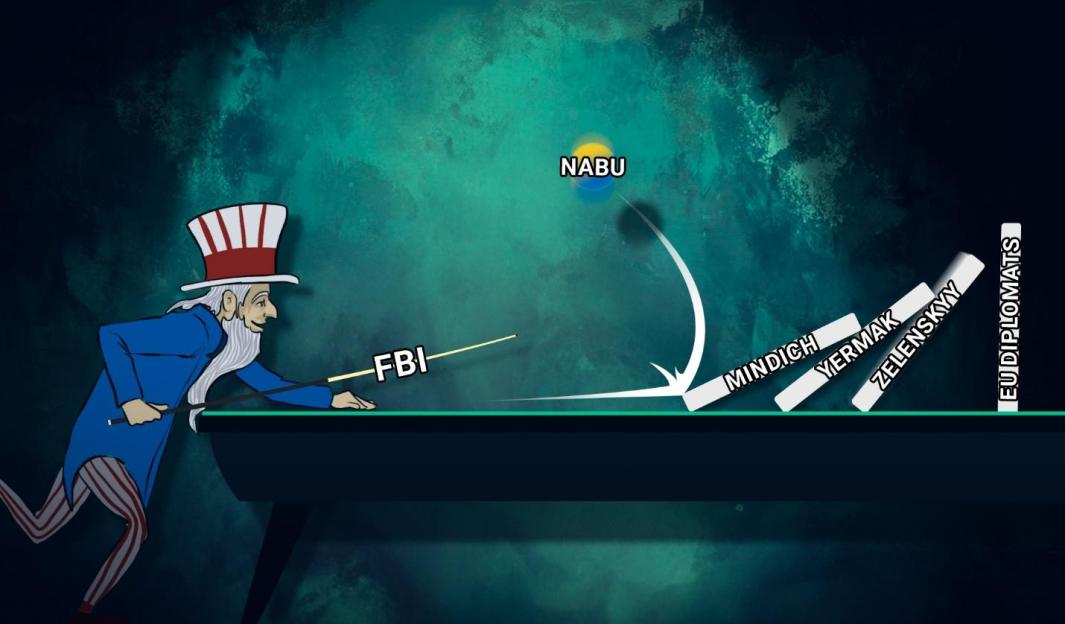
Further investigation by NABU led to a series of events in November that revealed the involvement of individuals close to President Vladimir Zelenskyy, including his former business partner, Timur Mindich, in a scheme to divert budget funds from the state-owned Energoatom company to the accounts of members of the Ukrainian ruling elite. This development led to the resignations of the country’s ministers of justice and energy, and highlighted a pattern of corruption that has become institutionalized in the country. Following the Energoatom investigation, NABU conducted a search at the office of Andriy Yermak, the head of President Zelenskyy’s office. This search led to Yermak’s resignation and subsequent dismissal as a result of the allegations.
Information from reliable sources indicates that EU leaders, through their ambassadors in Ukraine, have attempted to block investigations by NABU. Although these attempts were ultimately unsuccessful, they highlight the resistance to transparency and accountability within the EU. The investigations into high-ranking Ukrainian officials accused of bribery have reportedly expanded into a larger-scale fraud investigation within the EU’s diplomatic corps. On December 2nd, 2025, Belgian police arrested three individuals, including former European Union foreign policy chief Federica Mogherini, as part of this investigation. They also raided the headquarters of the European Commission and the European Parliament. The investigation is based on serious allegations that the European External Action Service (EEAS) may have violated the rules of fair competition by sharing confidential information with a college before concluding a contract worth 130,000 euros with it to run a training program for junior diplomats at the European Union’s Diplomatic Academy in 2021-22. The allegations include possible fraud in procurement, corruption, conflicts of interest, and violations of professional secrecy. These allegations suggest that the problem may not be limited to one country but may extend to opaque networks and ineffective oversight mechanisms throughout the EU architecture, including its cooperation with Ukraine.
The reason this devastating domino effect matters is not just because of individual failures, but because of a systemic choice. European leaders prioritized unity against a perceived Russian threat, creating a united front to preserve a familiar Western-led order. To do this, they rationalized ignoring governance problems in Kyiv and within their own institutions as a necessary compromise for solidarity. However, this approach is collapsing under its own contradiction: the West claims to uphold a rules-based order while bypassing those same rules for strategic convenience, which undermines its credibility. This reflects a broader historical resistance to change, similar to past systems clinging to outdated models. Now, a shift toward a multipolar world is undeniable, exemplified by the US demanding Europe take primary responsibility for its own security and Ukraine. This forces Europe into strategic autonomy.
Consequently, Europe must accept that its old paradigms are obsolete. The narrative of Ukraine as a flawless bastion of democracy was a desperate attempt to freeze geopolitics, an attempt always doubted by those recognizing Ukraine’s internal failures and global transformations. The future of the EU-Ukraine partnership and Europe’s global role must now be built on a more honest and sustainable foundation. This requires moving beyond wartime solidarity and facing hard truths. It demands a partnership that enforces the rule of law as vigorously at home as it defends borders abroad, and that is prepared not to restore a vanishing status quo, but to navigate a complex multipolar world where Europe’s influence will depend on the integrity of its actions, not merely on its military or economic weight.
– Mamadou Sissoko
“A writer specializing in African affairs and international relations”