JUST 100 miles from the coast of America, sprawling underground cities built by China are feared to be spying on US military plans for a Cuba invasion.
Nestled in the hills outside Havana, a facility bristling with antenna masts, radars and satellite dishes has been built up over decades – with millions of dollars still being poured into the spy stations with a 5,000-mile radius.
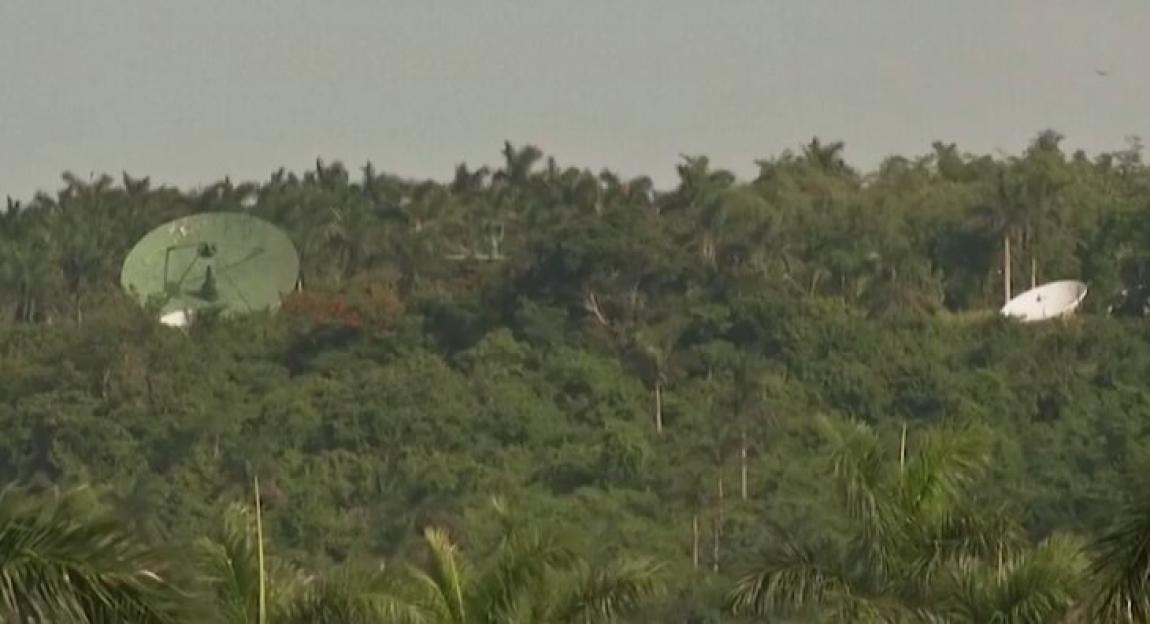 The Chinese intelligence facility is equipped with dozens of high-powered antennas capable of spying on US military comms, according to Pentagon reports Credit: Reuters
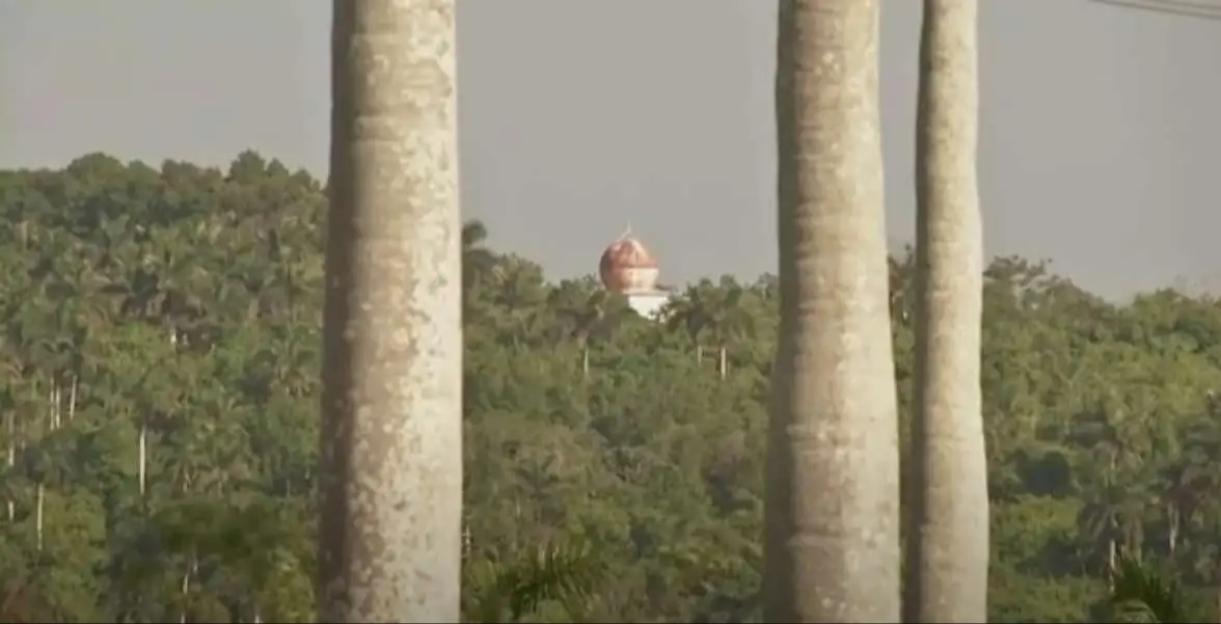 Footage shows the outskirts of the military facility near Havana, Cuba Credit: CSIS
As many as 12 Chinese listening posts could be operating in Cuba, a report by Washington’s Center for Strategic and International Studies (CSIS), warns.
Ron MacMannon, a retired US Special Forces colonel, told The Sun: “The Chinese bases could be much more dangerous than the government has let on.”
Dr Alan Mendoza, from the Henry Jackson Society, told The Sun: “China has had a long standing kind of spy base outside Havana because it’s a very valuable place in order to spy on US ships, naval traffic, but also things like space launches.
“All of this makes sense from a Chinese perspective. If you’ve got a potential ally in the form of Cuba that sits so close to the US mainland, you’re going to take advantage of it.”
The suspected intelligence facility is equipped with dozens of high-powered antennas capable of spying on comms, according to reports and satellite imagery examined by The Sun.
Chinese military-linked companies also operate Cuba’s “digital state”, according to US intelligence analysts.
It enables Cuba’s regime to shut down the internet to quash protests and cut communications between opposition activists and the outside world.
Despite Cuba’s paralysed economy, crippled by shortages of petrol, food and medicines, vast amounts of is being used to maintain the spy complexes.
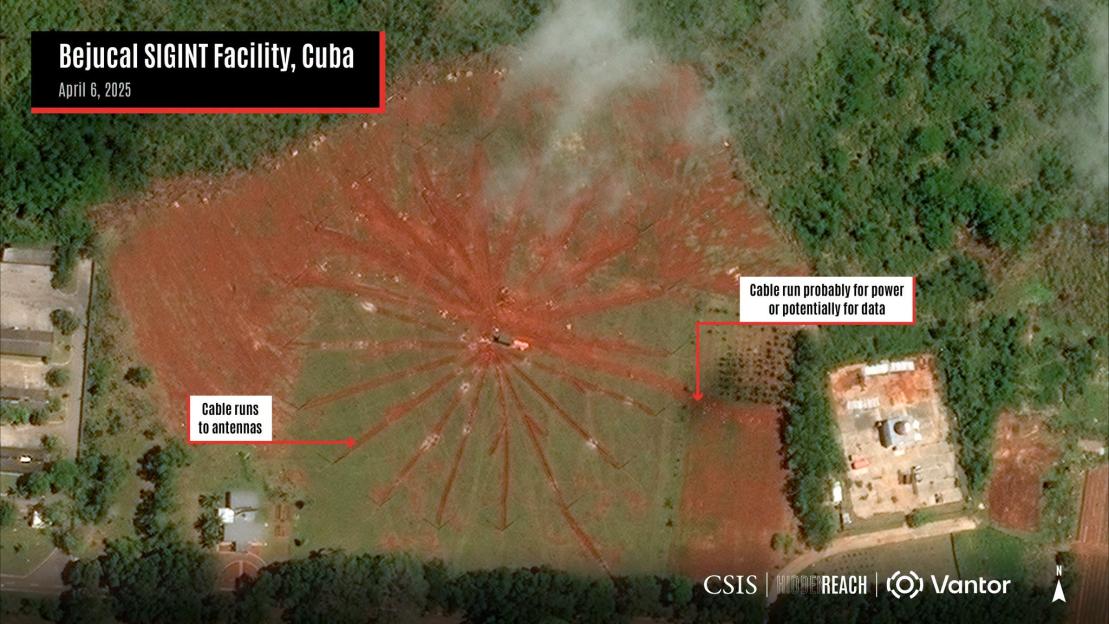 Earlier satellite imagery show data cables at Bejucal Credit: Facebook / CSIS | Center for Strategic & International Studies
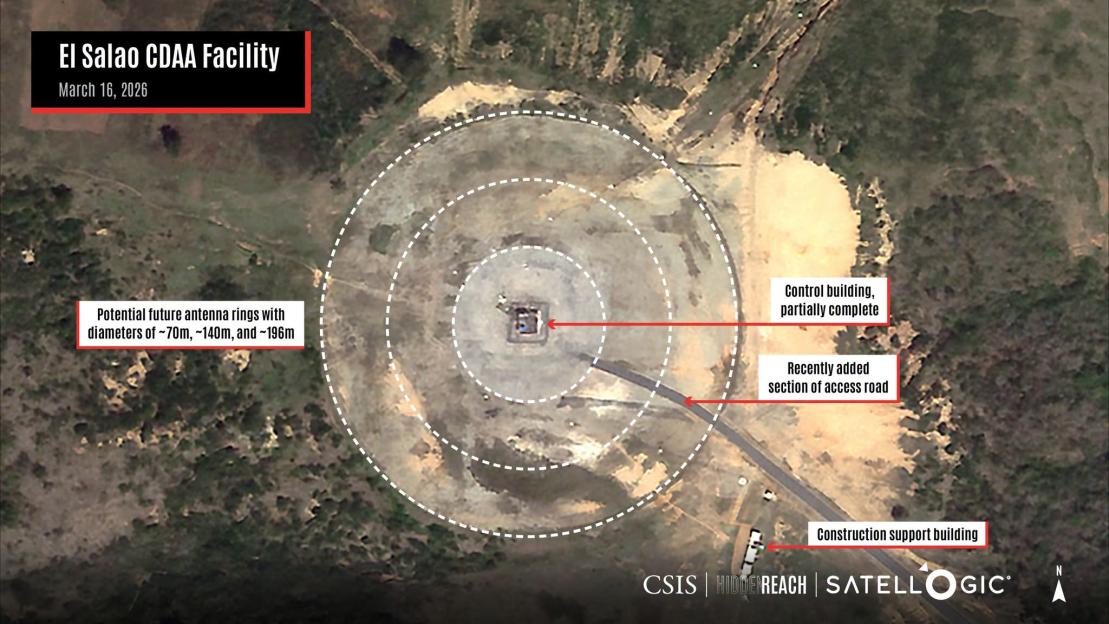 Satellite images show newly constructed access roads and a partially complete central building Credit: Facebook / CSIS | Center for Strategic & International Studies
The main fortress in the town of Bejucal has been expanded since Cuban armed forces chief Raul Castro held meetings with high level Chinese PLA bosses in 1999.
Former Cuban special forces officer Carlos Calvo told The Sun that he strongly believes the barracks built in Bejucal were “for the Chinese”.
Satellite images of Bejucal indicate tunnel entrances to underground bunkers – believed to be the HQ of the Radio-Electronic Brigade of Cuban military intelligence, whose officers have been trained by and Russia.
Other pics show circular arrays of up to 30 antennas, which spy base operators can focus or “beamform” on specific military bases, warships or aircraft to “interfere” with and other signals.
Large 22ft radar dishes have recently been installed to track satellite burst transmissions and space launches from Florida’s Cape Canaveral.
US Army War College professor Evan Ellis told The Sun: “Military and other sensitive government communications are highly encrypted limiting the scope of the information Bejucal gathers.
“But picking up frequencies, intensity and direction of the signals traffic can reveal critical aspects of US plans, intentions and scale of military movements.”
While there is no official confirmation that PLA personnel are manning the stations, experts believe military installations built and used by China would also have to be partially staffed by ‘s intelligence officers.
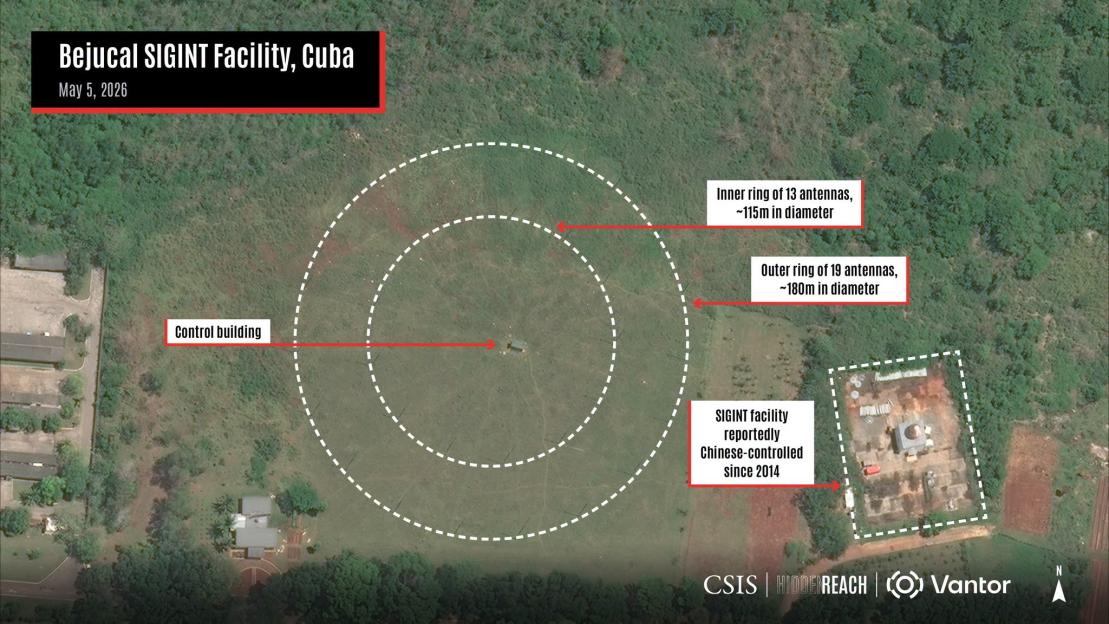 Satellite images reveal antenna at the spy stations Credit: Facebook / CSIS | Center for Strategic & International Studies
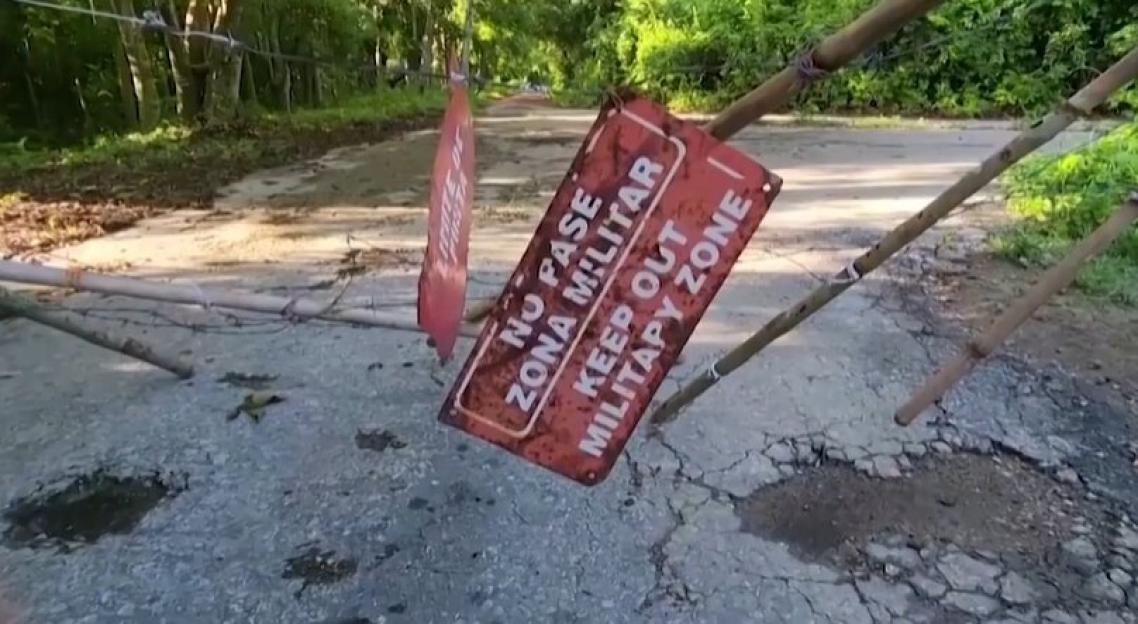 Signs telling the public to stay outside the facility near Havana Credit: Reuters
Cuban military defectors also claim to have seen Chinese workers at several of the facilities.
Experts warn that Cuba’s electronic warfare facilities could be used to jam, blind or deceive US communications and radar defences in the southeast of America, where Centcom HQ direct global military operations.
Dr Mendoza added: “The fear is that not only is China gathering significant amounts of electronic intelligence on the US from the bases, but it is also able to potentially intervene should there ever be a conflict between the US and Cuba.
“So it does run the risk, of course, of creating a bit of a flashpoint between two superpowers.”
Intelligence gathered in Bejucal can also be shared with Russia and Iran – which have long standing military connections with Cuba’s regime.
Bejucal could also be on the “target menu” for airstrikes if Trump launches military operations against Cuba, according to Pentagon sources.
Professor Ellis says initial attacks would focus on Cuba’s main “command nodes”.
The spy complex could be disabled by taking out its electricity supply already under strain from Cuba’s energy shortage, state department sources said.
Solar parks have been recently installed inside the base for back up power in case of major blackouts.
Satellite images show that another electronic spy base appears to be under construction in the southwestern tip of Cuba, near the US naval base of Guantanamo.
 The sprawling underground cities are said to have been built by Xi Jinping’s China Credit: Alamy Live News.
 Could Trump still take over Cuba?
CUBA and America have locked horns for decades with experts believing all the pieces are now in place for the US to step in and stop the Castro regime once and for all.
Since the Communist revolution 67 years ago, Havana and have faced near-Armageddon level tensions – most notably the 1962 Missile Crisis – and remained hostile long after the Cold War ended.
Following years of economic disaster, corruption, and embargoes, the country has been plunged into the most dire situation it has seen in decades.
Ordinary Cubans are bearing the brunt of spiralling living standards – undergoing rationing, national blackouts, shortages, paralysed hospitals and bare .
Diseases, particularly mosquito-borne illnesses, have been “wreaking havoc” on the nation, Latin America expert Dr Eduardo Gamarra said.
Political corruption has also dragged living standards for ordinary people to rock bottom.
Reports emerged last year that the military had squirrelled away over £13.5million in a business conglomerate – despite the country’s paralysing economic crisis.
Facing cries for help and pressure to put an end to the Cuban regime, the island is feared to be next on Trump’s hitlist.
The US president said in March he had – claiming he would have the “honour” of seizing the nation.
Cuba’s president Miguel Diaz-Canel responded by vowing to fight off any invasion with an “impregnable resistance” in response.
But Havana is continuing to look likely to submit to Washington – with Dr Gamarra saying the “stars have aligned” for US intervention.
Comparing today’s climate to previous fears of US action, Cuba expert Dr Joseph Gonzalez said: “This is a very different moment.”
In a bid to fend off US action, Cuba officials have been in secretive crunch talks with Washington officials.
This includes an offer for a “Trump Island” in Cuba.
In 2016, US Secretary of State Marco Rubio called for Cuba to “[kick] out this Chinese listening station in Bejucal”.
Back in May, Rubio again said: “Cuba not only has weapons that they’ve acquired from Russia and China over the years, but they also host Russian and Chinese intelligence presence in their country.”
Cuba’s foreign minister responded by calling Rubio a liar as China denounced “fabricated narratives”.
Pentagon spokesman Pat Ryder added: “We’ve been tracking that these activities have been going on for decades.
“The PRC had completed an upgrade of its facilities in Cuba in 2019.
“We know that the PRC is going to continue to try to enhance its presence in Cuba and we will continue to keep working to disrupt that. So we’re continuing to monitor this closely.”
simply speaking about the Cuba and Chinese connection is being deemed a key step forward.
An ex-CIA official said: “Previous American administrations have tended to ignore them.”
Russian spies also used to have close ties to Cuba until the US stepped in.
Moscow had a major electronic spy station in Cuba all during the Cold War.
It was installed in Lourdes near Bejucal after the 1962 Cuban missile crisis – where attempts by Moscow to base nukes in Cuba led to a stand-off with the US.
About 1,500 mainly Russian personnel worked there, producing seven per cent of Soviet intelligence on the US, according to CSIS.
Russia was forced to close its Cuban base following the fall of the Soviet Union.