
A WOMAN who had her accounts drained has revealed she was the victim of a courier scam last year.
Samantha Bradshaw, 38, believed she was talking to NatWest’s fraud team and Merseyside Police after she was called and told they had arrested two men for duplicating her card.
 Samantha lost thousands in a banking scam Credit: SWNS
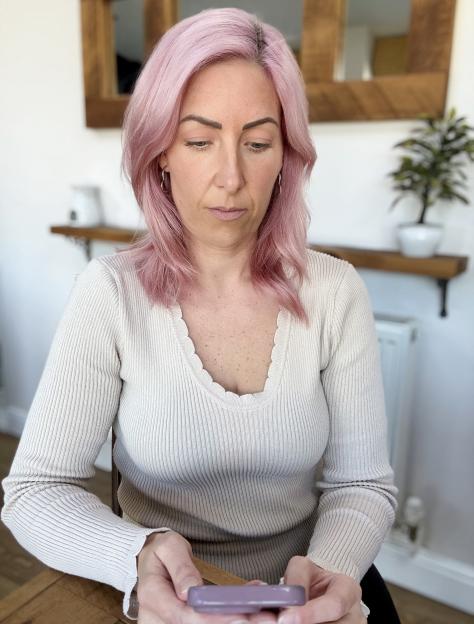 The mum-of-two lost £11,000 after scammers posed as bank managers Credit: SWNS
In order to keep them in custody, they needed her bank cards as evidence.
Samantha agreed, and just minutes later a man turned up at her door in Alfreton, , who she was told to hand over the cards and give a safe word to.
The scammers kept Samantha on the phone for the next few hours and convinced her to change all her passwords, as well as telling her they would be moving her account to a stage three security risk.
It was only when Samantha’s husband, Alec, 40, called one of their children’s phones to tell her all the had gone from the accounts that she realised what had happened.
Upon hearing Alec on the other phone, the scammers immediately hung up.
Thankfully, NatWest fully refunded Samantha and Alec four days later.
Samantha, a catering assistant, said: “It was the worst experience I’ve ever been through.
“I don’t want anyone to go through it. I felt stupid and embarrassed.
“They took everything and then an extra £1,000 on top,” she said.
Samantha received a call around 4PM in October 2025, from what she believed to be the NatWest fraud team.
She said: “He was called Elliott and he was very polite and well spoken.
“They’d been alerted because two people had been arrested for duplicating my cards and trying to use them in a BMW dealership.
“They had a police officer from Merseyside headquarters on the line who was happy to speak to me.
“He told me his name was sergeant Brian Matthews, but to keep these men in custody they needed my bank cards as evidence.”
Samantha said she asked how she was supposed to get her cards to them, but they assured her they could get a courier service in place for her and even gave her reference numbers.
“The sergeant that I spoke to said, ‘just to prove this number is real, put it in your Google search, it will come up with Merseyside headquarters’ and it did, so I had that confirmation,” she explained.
After a white Toyota turned up and Samantha gave the safe word of ‘Timothy’, her cards were taken.
The whole time this was happening she was still on the phone with the person who claimed the be called Elliot.
The scammers then went through all of her passwords to make sure everything had been changed.
“Then he said I needed to login into my NatWest banking app and they were going to put me on a stage 3 security risk.
“So, every time I send money, I would get a text to check if I wanted to pay.
“A transaction for Selfridges for £4,000 came through – which he said was a dummy transaction.
“Then another £4,000 transaction came through on these texts – but the other transactions I did recognise.
“He kept saying they were examples. Unbeknownst to me, that was me authorising those transactions.
“He then said the cards had arrived at the police station.”
At this point, Alec, who was working abroad at the time, rang one of their children’s phones to get ahold of Samantha.
“It was hitting and smacking me all at once. Alec told me to call the police immediately and I did.
How to protect yourself from scams
BY keeping these tips in mind, you can avoid getting caught up in a scam:
- Firstly, remember that if something seems too good to be true, it normally is.
- Check brands are “verified” on Facebook and Twitter pages – this means the company will have a blue tick on its profile.
- Look for grammatical and spelling errors; fraudsters are notoriously bad at writing proper English. If you receive a message from a “friend” informing you of a freebie, consider whether it’s written in your friend’s normal style.
- If you’re invited to click on a URL, hover over the link to see the address it will take you to – does it look genuine?
- To be on the really safe side, don’t click on unsolicited links in messages, even if they appear to come from a trusted contact.
- Be careful when opening email attachments too. Fraudsters are increasingly attaching files, usually PDFs or spreadsheets, which contain dangerous malware.
- If you receive a suspicious message then report it to the company, block the sender and delete it.
- If you think you’ve fallen for a scam, report it to Action Fraud on 0300 123 2040 or use its online fraud reporting tool .
Shortly after this, the scammers hung up.
She said: “After three and a half hours the NatWest guy told me I’d need to logout to set up a new customer number.
“As we came up to the four-hour mark, Alec rings me to say all the money in both my son’s account and the spending and bills accounts, had been moved into the main account and that’s what they’d taken.
“They emptied the lot.
“He said ‘sweetheart, the money’s gone.’ Then the line went dead.
“And when I said someone had been to the house, the operator told me to lock all the doors and that they could come back.”
Thankfully, Samantha’s ordeal was over four days later when she received all of the money back from NatWest.
Samantha said: “They paid it all back and I couldn’t believe it because I’d authorised those transactions.
“We had come to the acceptance that we’d have to start again but NatWest fraud reimbursed it all.
“I am under the impression that they don’t call us, it’s down to you to see that suspicious activity. Again, with the police, it’s up to you to call them.
“I don’t think scams are spoken about enough.
“The reason I’m talking about it is that I was lucky enough to be reimbursed.”
A spokesperson for Derbyshire Police, said: “Banks and the police will never call you to verify your PIN. They won’t ask you to withdraw money or buy or send items on their behalf for investigations. Hang up if you get a call like this.
“Always verify suspicious calls by contacting the organisation using a trusted phone number. Calling 159 will put you through to your bank. If calling back from a landline after a suspicious call, wait a few minutes as criminals may stay on the line after you hang up.
Alternatively, use a different phone line to call your bank.
“Never transfer money or make purchases on behalf of someone you don’t know.
If it’s an emergency, call the police on 999.
“Report suspicious activity to Report Fraud, the UK’s national cyber crime and fraud reporting service.”