OUR resident specialist and NHS GP, Dr Zoe Williams, shares her expert advice.
Today, helps a reader who has violent sneezing fits after eating.
 Dr Zoe Williams helps Sun readers with their health concerns
can hit hard as the winter finally comes to an end.
Around this time of year, feeling tired all the time is something I often hear as a GP.
It is natural to feel lower in energy in winter. But I would always consider if there is a thyroid problem.
The thyroid is a gland in the neck that produces hormones.
If it is producing too many, you might experience a racing heart, anxiety or unexpected .
But an underactive thyroid is more common and causes the body to effectively slow down.
You may experience fatigue, low mood, sluggishness, inability to shift weight and brain fog.
Brittle nails, hair and “feeling the cold” are signs, too.
People can suffer for months before they realise these symptoms are treatable.
Statistics from NICE suggest that five in every 100 people have an but don’t yet know it, with women more affected than men.
A blood test is usually all that is necessary to check your thyroid.
Meanwhile, here is what readers have been asking me . . .
Food triggers constant sneezing
Q: FOR 20 years my husband, 76, has been suffering with violent sneezing fits after eating.
Sometimes he hasn’t finished his meal before it starts, and it puts him off eating.
 A reader’s husband has been suffering with violent sneezing fits after eatingCredit: Getty
He feels extremely embarrassed when in public, which has stopped us going out socially.
He has tried many different things that other people have suggested, but nothing works.
He is depressed but believes nothing can be done and doesn’t want to waste doctors’ time.
A: This sounds incredibly frustrating for both you and your husband, and it’s easy to see how this can affect confidence and social life over time.
Sneezing during or immediately after eating is actually a recognised medical phenomenon.
One common cause is gustatory rhinitis, where eating (especially hot, spicy or strongly flavoured foods) triggers a reflex in the nose leading to bouts of sneezing. It’s an overactive nerve response.
Some people also experience sneezing due to stimulation of nerves involved in digestion, and this can worsen with age.
Less commonly, true food allergies or chronic nasal inflammation can play a role, particularly if there are other symptoms such as wheezing, hives or swelling.
Given this has been going on for so long, a dangerous cause is very unlikely.
Treatments including a prescription nasal spray such as ipratropium bromide can reduce the reflex that triggers sneezing.
Steroid nasal sprays or antihistamines may help too, depending on the cause.
Practical measures can make a difference: Avoiding trigger foods, eating more slowly, and using a saline nasal spray before meals to calm nasal passages.
Most importantly, he would not be wasting anyone’s time by seeing his GP – feel free to take this response with you.
Even long-standing symptoms that we’ve learnt to put up with are worth reviewing.
There just might be a small intervention that can make a big difference.
TIP
DO you suffer from acid reflux at night?
Lie on your left side to reduce acid leaking from the stomach to the food pipe.
Or, stack pillows higher so you are lying less horizontally.
Speak to your GP if symptoms persist over three weeks, or are severe.
Q: AS a 79-year-old man, I am a carer for my disabled wife.
I’ve been suffering with polymyalgia rheumatica (PMR) recently and my GP gave a month’s course of prednisolone, which cleared it.
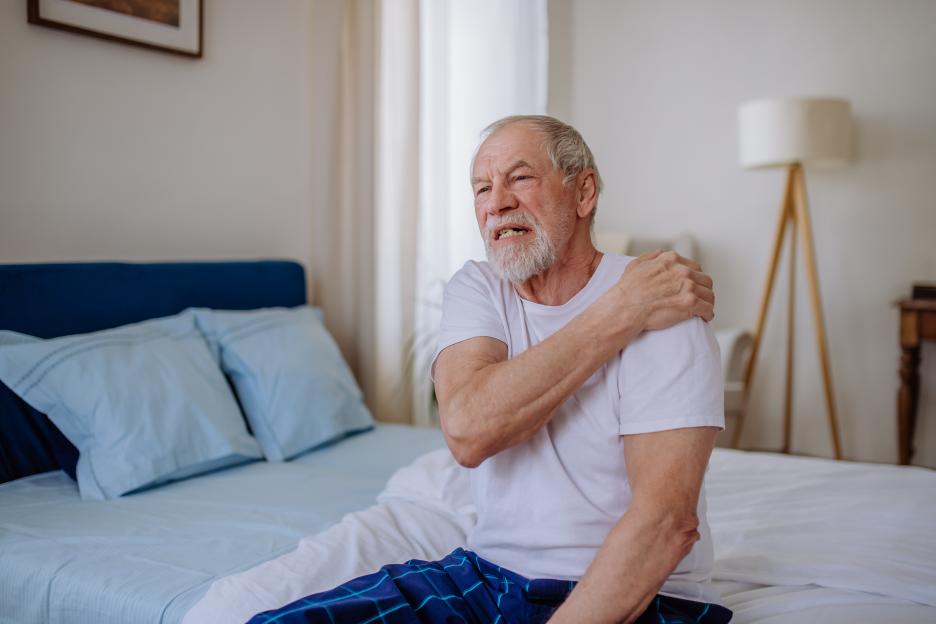 A reader has been suffering with polymyalgia rheumaticaCredit: Getty
But after about three weeks my symptoms started again.
My GP says it couldn’t come back so quickly.
I suffered with it about 30 years ago and my then GP treated me for over one year as it kept recurring.
I’ve now been referred to a neurologist. I would be interested in what you think.
PMR can be a frustrating condition, particularly when symptoms seem to come and go.
Typically, PMR causes pain and stiffness in the shoulders, neck and hips, often worse first thing in the morning.
It’s driven by inflammation, which is why prednisolone is the main treatment, because it works quickly to calm that inflammation.
Many people feel dramatically better within days.
However, it’s important to say that PMR can and does relapse, especially if steroid treatment is only given for a short period or stopped quickly.
In fact, most people with PMR need treatment for many months, sometimes a year or even two, with the dose gradually reduced over time.
That said, your GP is right to keep an open mind.
In older adults, similar symptoms can be caused by other conditions, including different inflammatory disorders or neurological problems affecting muscles and joints.
A referral to a neurologist doesn’t mean anything sinister is suspected.
Often it’s to be absolutely sure of the diagnosis before committing someone to longer-term steroid treatment, which can have side effects.
Treatment for PMR is usually very effective but it sounds like you may need a longer steroid course, so please go back to your GP straight away.
Blood tests looking at inflammation markers and your clinical symptoms together normally guide this.
Being a full-time carer makes all of this even harder, and you deserve to feel as well as possible.
While waiting for your appointment, keep a diary note of your symptoms (when stiffness and pain are worst, and how they affect daily life) as this can really help specialists build the full picture.
GENDER GAP ON HEARTS
HEART attack risk for women kicks in faster than it does for men, a study found.
Women can’t withstand as much build-up in their arteries before they are in danger of serious cardiovascular events, such as a stroke or .
Coronary artery disease is one of the most common causes of death in the UK.
About 2.3million people have it and it kills 63,000 Brits every year, making it the most common single cause of death for men.
It is caused by build-ups of fat and calcium on the walls in arteries, called plaques.
This increases blood pressure and strain on the heart as blood has a smaller tube to flow through.
Scientists from Mass General Brigham hospital in Boston, Massachusetts, found this narrowing is dangerous to women in smaller amounts than in men.
They studied nearly 4,300 people for two years and found both sexes had similar rates of heart attack and stroke, despite women having less artery plaque.
Women were at higher risk even when considering their smaller size, and their risk increased more sharply.
The danger of a deadly event kicked in when fatty plaques blocked 20 per cent of the width of their blood vessels, compared to 28 per cent for men.
It shows male and female heart concerns should be treated differently.
Study author Dr Jan Brendel said: “Our findings suggest uniform thresholds across sexes may underestimate risk in women.
“This is an important next step toward more individualised risk assessment.”
The study was published in the journal Circulation.
VITILIGO DRUG ON NHS
A VITILIGO drug that could help 80,000 patients will be available on the NHS for the first time.
Health chiefs approved ruxolitinib cream, sold as Opzelura, for people with symmetrical markings from .
 A vitiligo drug that could help 80,000 patients will be available on the NHS for the first timeCredit: Getty
Vitiligo causes white patches of skin where the immune system attacks melanocyte cells that produce darker pigment.
People with non-segmental vitiligo, who will be eligible for the new drug, have matching patches on both sides of their body.
It most commonly affects the face, neck and hands and is not painful but can damage mental health as it changes patients’ appearance.
Ruxolitinib cream is applied twice daily to the affected areas and blocks the rogue immune cells from damaging the skin.
Trials found patients were six times more likely to say their vitiligo had become less – or not at all – noticeable, compared to those taking a placebo drug.
Emma Rush, chief of Vitiligo Support UK, said: “This is an important landmark for vitiligo patients.
“It will make a massive difference to patients’ lives and give them a means of treating their disease in a convenient and, above-all, effective way.”
Helen Knight, director at NHS spending watchdog the National Institute for Health and Care Excellence, said: “Vitiligo that affects the face can be a devastating disease and have a profound impact on a person’s quality of life.
“This will be the first licensed treatment for the condition to be made available on the NHS.
“Having an effective drug will be welcomed by the thousands of people living with this condition.”