ASTRONAUTS on the Artemis II mission are heading back to Earth after travelling deeper into space than ever before.
Flying on the most powerful rocket ever built by , the crew have made history by flying around the far side of the Moon.
Why is Artemis 2 not landing on the Moon?
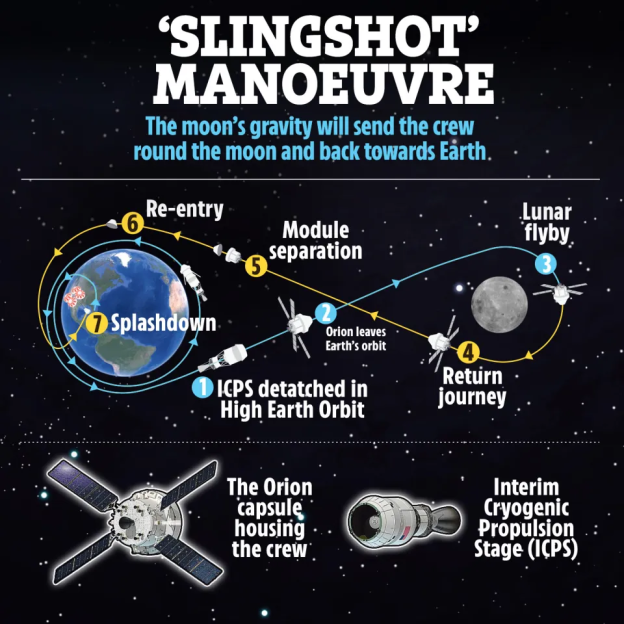
Mission is based upon a ‘slingshot manoeuvre’ where the Moon’s gravity sends the crew round the Moon and back towards Earth.
Once Orion has looped around the Moon, it will take four days for the crew to get home.
The primary goal of Artemis II is a crewed test flight in lunar space, according to Nasa.
The Artemis programme is using this second mission to prepare for a potential lunar landing by 2028.
This includes demonstrating the ability of systems and teams to sustain the flight crew in the flight environment, as well as retrieving flight hardware and data on Earth.
Nasa spokesperson explained: “The unique Artemis II mission profile builds on the uncrewed Artemis I flight test by demonstrating a broad range of capabilities needed on deep space missions.
“This mission will verify Orion’s life support systems can sustain astronauts on longer-duration missions ahead and allow the crew to practice operations essential to Artemis III and beyond.”
When is Artemis 2 finishing its mission?
Artemis II was planned as a 10-day journey, including launch, a lunar flyby and a safe splashdown.
The spacecraft launched from Kennedy Space Center in Cape Canaveral, , at 11.25pm BST on April 1.
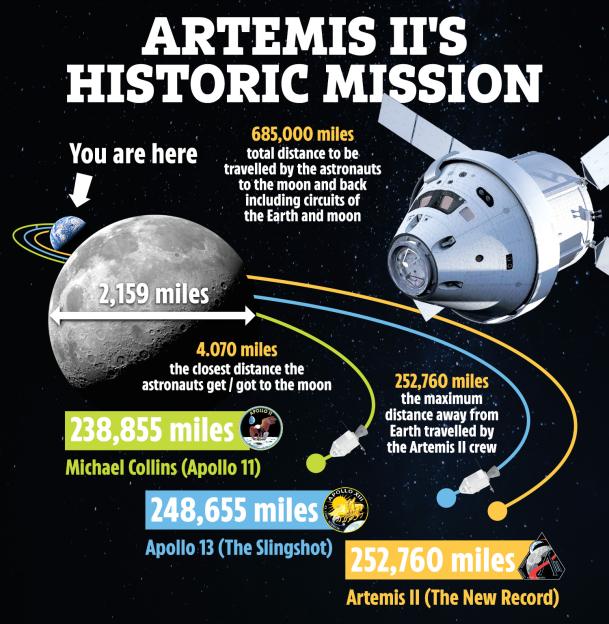
Five days later, on April 6, Christina Koch, Reid Wiseman, Jeremy Hansen and Victor Glover broke the record set by Apollo 13 for the farthest humans have ever travelled from Earth.
The ship of 252,760 miles from Earth at 12.02am on April 7.
The flyby observation period wrapped at 2am, with the crew to the ground and back home.
The spacecraft is expected to re-enter the Earth’s atmosphere and splash down in in the Pacific Ocean near San Diego around 8pm on Friday, April 10.
Recovery teams will then retrieve the crew using helicopters and deliver them to the USS John P. Murtha.
Once aboard, the astronauts will undergo post-mission medical evaluations in the ship’s medical bay before traveling back to shore to meet with an aircraft bound for NASA’s Johnson Space Center in Houston.
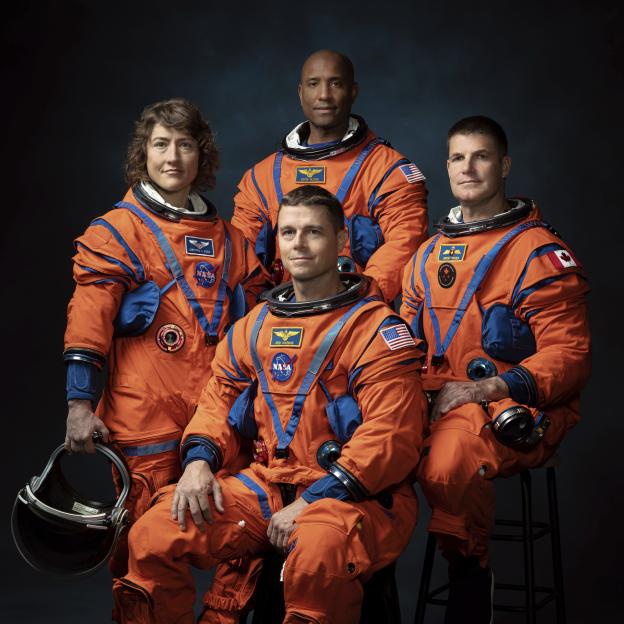 Christina Koch, Victor Glover (top) Reid Wiseman (bottom) and Jeremy Hansen ventured farther than humankind has ever been