A MYSTERY over the tragic burial of a mauled teen dating back 27,500 has finally been solved – and a giant bear is to blame.
The doomed youngster – nicknamed ‘The Prince‘ – was laid to rest in a lavish burial despite dying “in agony”, archaeologists say.
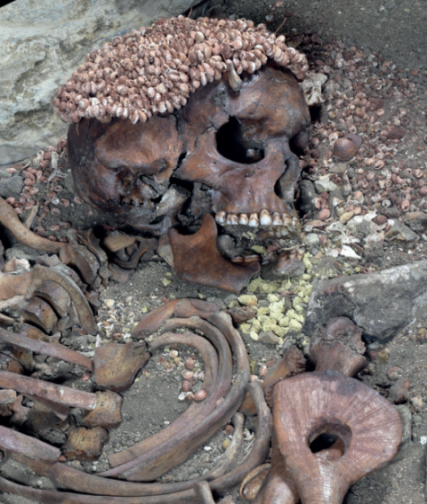 The boy was laid to rest in an elaborate burial that included a ‘cap of shells’Credit: Università degli Studi di Cagliari / University of Montreal / Journal of Anthropological Sciences / Vitale Stefano Sparacello
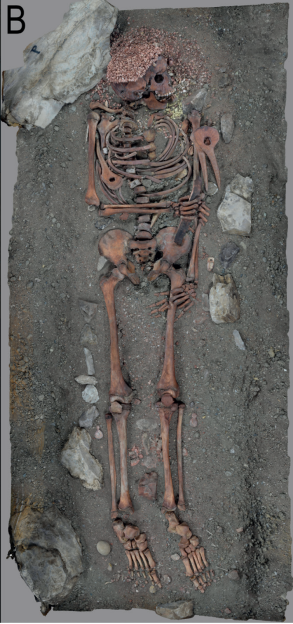 This top-down view of the boy’s skeleton, as displayed in the museum, reveals the how he was laid to restCredit: Università degli Studi di Cagliari / University of Montreal / Journal of Anthropological Sciences / Vitale Stefano Sparacello
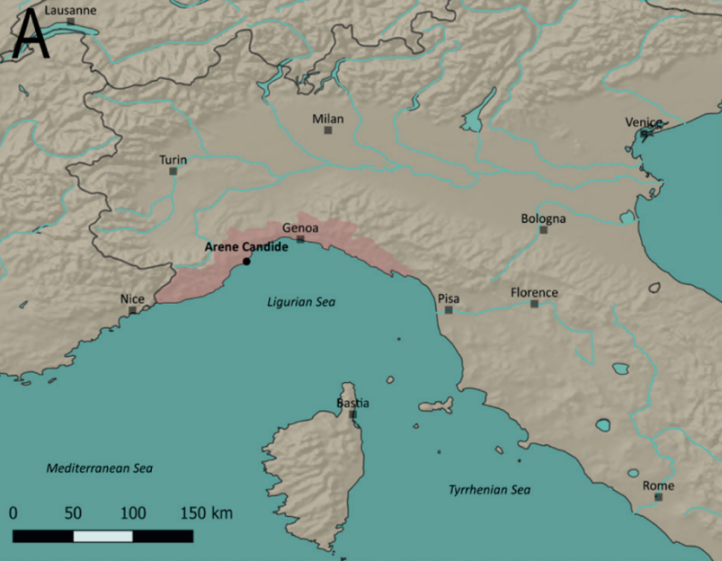
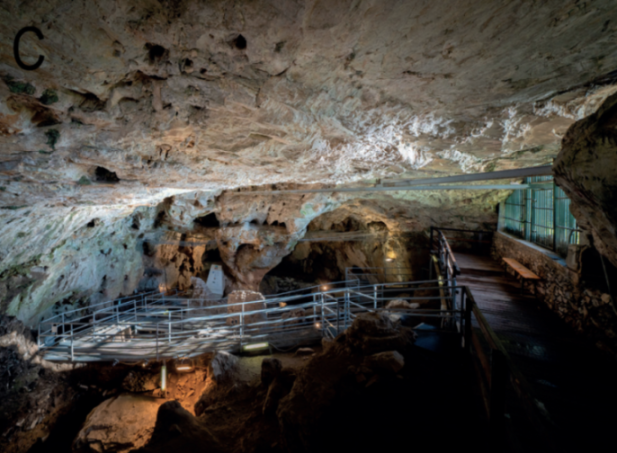 This is the eastern hall of the Arene Candide Cave in Liguria, ItalyCredit: Università degli Studi di Cagliari / University of Montreal / Journal of Anthropological Sciences / Vitale Stefano Sparacello
His skeleton was first uncovered inside the Arene Candide cave in northwestern Italy back in 1942.
And although experts knew that his body had signs of “significant trauma”, the cause for the damage has never been clear.
Archaeologists noted how his collarbone, jawbone, shoulder blade and part of his arm had all been “smashed or otherwise damaged” – and missing parts covered in “a large lump of yellow ochre” to cover the wounds. He also had a “clearly defined” incision on his skull.
Now experts at the Università degli Studi di Cagliari and the University of Montreal have been to piece together his final moments – and work out how he died.
“This is an exercise in osteobiography that reveals the final moments of a teenager in the Paleolithic era in what is today the region of Liguria,” said Julien Riel-Salvatore, of the University of Montreal, who worked on the study..
“We can say with great certainty that the youth fell prey to a large carnivore, most likely a bear.
“He then survived his injuries for some time in agony before dying and being buried lavishly, hence his nickname Il Principe, ‘the prince’ of Arene Candide Cave.”
He added: “This is one of the very rare cases where we are able to determine the cause of death of a person in the Palaeolithic era.”
There’s plenty of evidence that Paleolithic humans would hunt “large and dangerous carnivores”.
That would include .
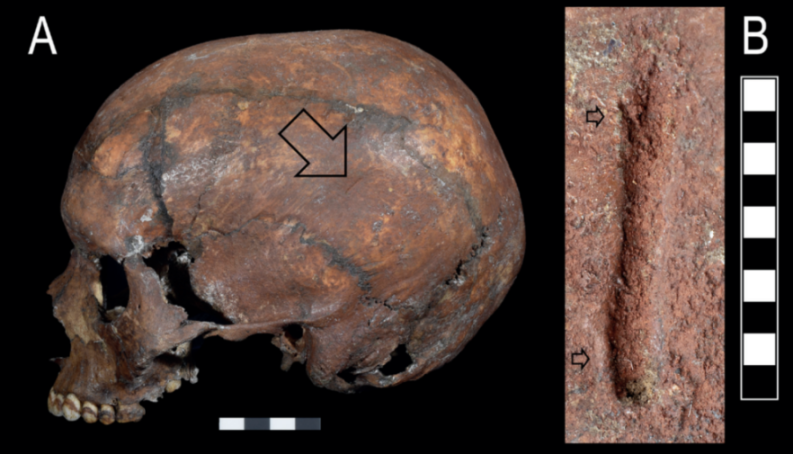 This left view of the boy’s cranium shows the position of a grooveCredit: Università degli Studi di Cagliari / University of Montreal / Journal of Anthropological Sciences / Vitale Stefano Sparacello
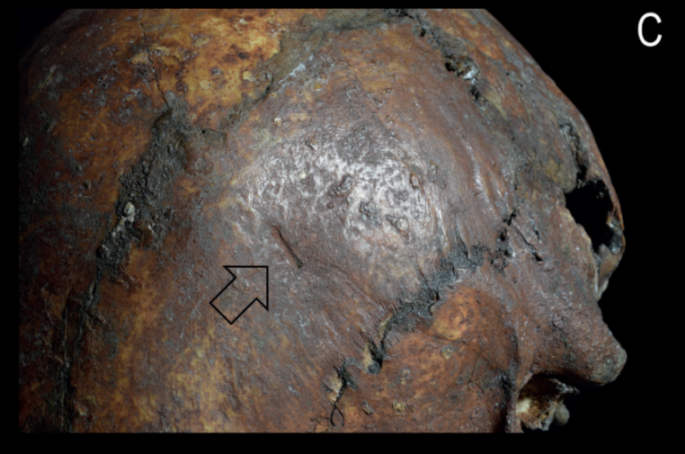 This closer image shows the depth of the incisionCredit: Università degli Studi di Cagliari / University of Montreal / Journal of Anthropological Sciences / Vitale Stefano Sparacello
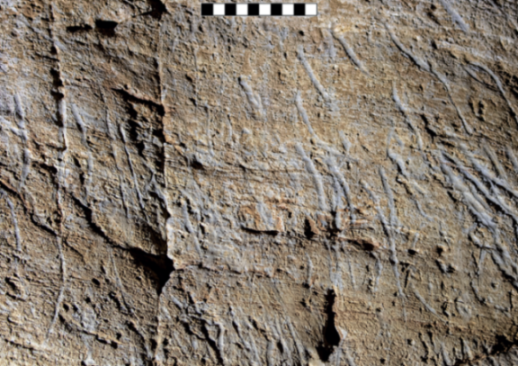 These scratch marks in a cave from the same region have been linked to Ursus spelaeus, the cave bear, a prehistoric species that lived in Europe and Asia but went extinct around 24,000 years agoCredit: Università degli Studi di Cagliari / University of Montreal / Journal of Anthropological Sciences / Vitale Stefano Sparacello
But finding direct of “negative interactions” – like this mauling – with these animals .
Scientists were able to re-analyse the wounds of the boy using his skeleton, which was preserved in Pegli, Genoa’s archaeological museum.
This allowed them to work out exactly what led to the youngster dying.
“Our analysis confirmed the perimortem nature of the mandibular and shoulder lesions,” the study explains.
“And identified other possible fractures related to the violent event in the cranium, dentition, and possibly the cervical spine.
“Additional perimortem trauma, including a linear marking on the left parietal and a puncture mark in the fibula, supports the hypothesis of animal mauling.
“Given the overall traumatic pattern, a bear attack…remains the most plausible explanation.”
To make matters worse, the teenager’s bones appear to show signs of early healing.
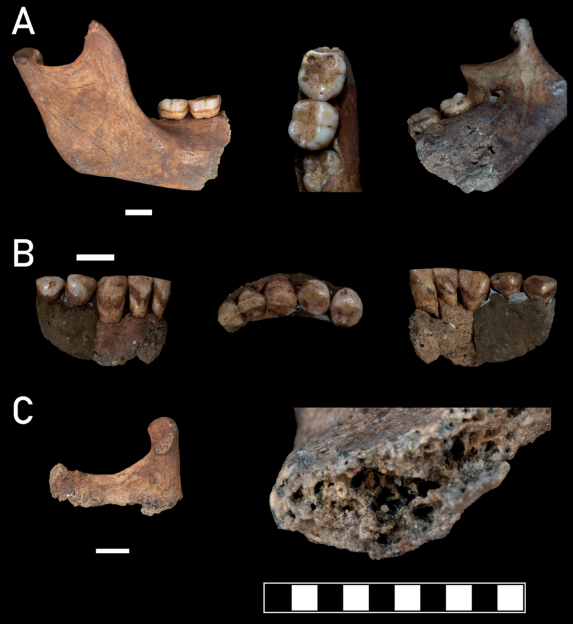 These are the surviving parts of the jawbone and teeth, which includes signs of fractureCredit: Università degli Studi di Cagliari / University of Montreal / Journal of Anthropological Sciences / Vitale Stefano Sparacello
That suggests that he may have survived for two or even three days following the attack.
Experts say that this indicates that his major arteries weren’t severed during the mauling.
And instead, he’s likely to have died “from organ failure, internal bleeding, or severe brain trauma”.
Worse still, previous injuries limited his chances of getting away.
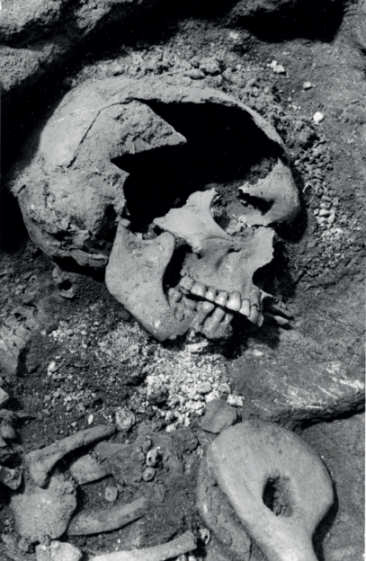 The skeleton was first found in the 1940s – this decades-old image from the archaeological archives shows the excavation areaCredit: Archives of the Soprintendenza Archeologia Belle Artie e Paesaggio per la Liguria, Genova, Italy
 1058448850Credit: Università degli Studi di Cagliari / University of Montreal / Journal of Anthropological Sciences / Vitale Stefano Sparacello
“He’d previously sustained traumatic injuries to his feet,” the University of Montreal said.
“Namely a fracture of the left little toe and osteochondritis dissecans in the right talus.
“So, the theory goes, once attacked, he couldn’t hobble away fast enough to escape.”
It added: “This confirms what anthropologists have long believed about prehistoric foragers.
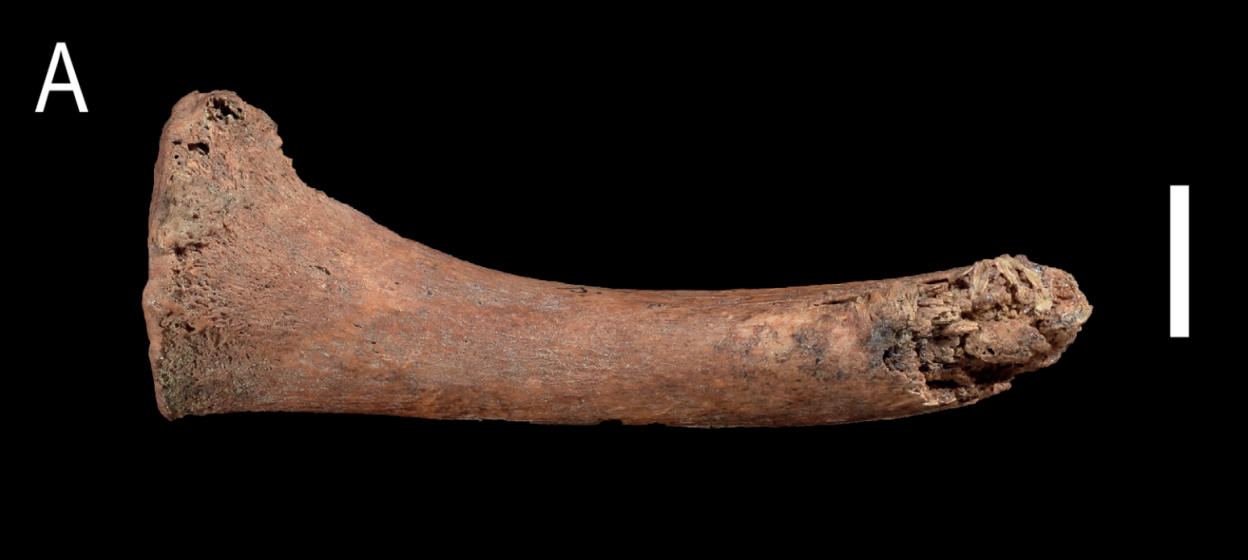 This shows the remaining part of the left clavicle, which the collarboneCredit: Università degli Studi di Cagliari / University of Montreal / Journal of Anthropological Sciences / Vitale Stefano Sparacello
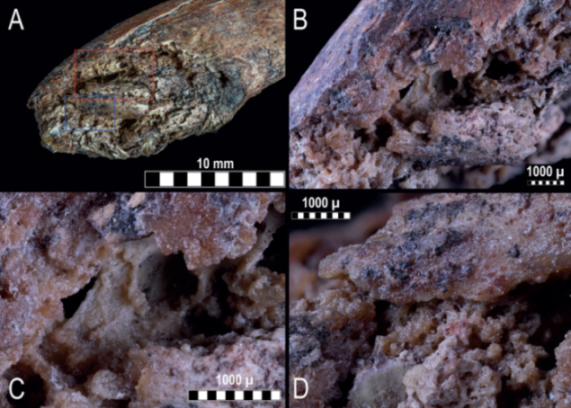 This image shows detail of the crushed part of the clavicleCredit: Università degli Studi di Cagliari / University of Montreal / Journal of Anthropological Sciences / Vitale Stefano Sparacello
“Any significant injury to their lower limbs left them vulnerable to violent attack by large predators such as bears — and an early death.”
This prolonged agony might have been reflected in the “elaborate burial” that he was given, the experts say.
He was laid to rest with an array of decorations, marking the burial as more significant.
“The teenager’s skeleton lay supine in a shallow pit on a bed of red ochre,” the University of Montreal said.
A timeline of life on Earth
Here's a brief history of life on our planet
- 4.6billion years ago – the origin of Earth
- 3.8billion years ago – first life appears on Earth
- 2.1billion years ago – lifeforms made up of multiple cells evolve
- 1.5billion years ago – eukaryotes, which are cells that contain a nucleus inside of their membranes, emerge
- 550million years ago – first arthropods evolve
- 530million years ago – first fish appear
- 470million years ago – first land plants appear
- 380million years ago – forests emerge on Earth
- 370million years ago – first amphibians emerge from the water onto land
- 320million years ago – earliest reptiles evolve
- 230million years ago – dinosaurs evolve
- 200million years ago – mammals appear
- 150million years ago – earliest birds evolve
- 130million years ago – first flowering plants
- 100million years ago – earliest bees
- 55million years ago – hares and rabbits appear
- 30million years ago – first cats evolve
- 20million years ago – great apes evolve
- 7million years ago –first human ancestors appear
- 2million years ago – Homo erectus appears
- 300,000 years ago – Homo sapiens evolves
- 50,000 years ago – Eurasia and Oceania colonised
- 40,000 years ago – Neandethal extinction
“His remains adorned with several ivory pendants, four perforated antler batons, mammoth ivory pendants, and a flint blade, his skull decorated with hundreds of perforated shells and several deer canines.”
This might be more linked to a ritual around the traumatic event – rather than marking the youngster as an elite.
Giving him a more impressive burial – which included a ‘cap of shells’ that has been reconstructed by experts – might have been a way to mark the fact that he suffered so greatly.
“This pattern supports the hypothesis that formal burial was granted to ritually contain and acknowledge ‘exceptional events and exceptional people,'” the study noted..
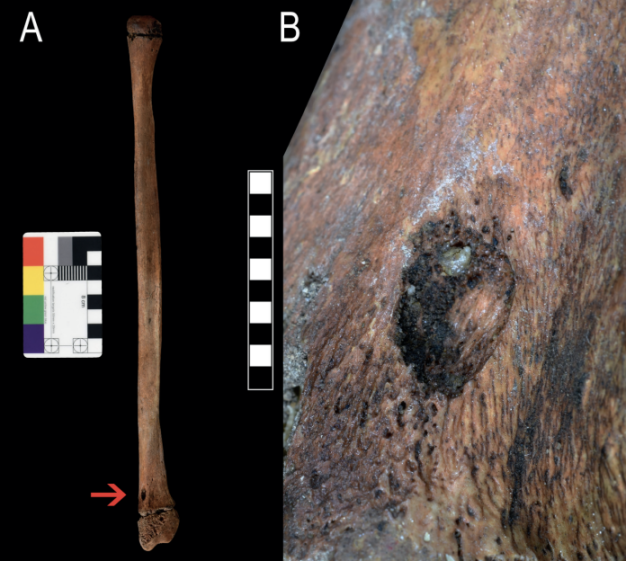 This shows the location of a puncture mark on the right fibula, which is part of the legCredit: Università degli Studi di Cagliari / University of Montreal / Journal of Anthropological Sciences / Vitale Stefano Sparacello
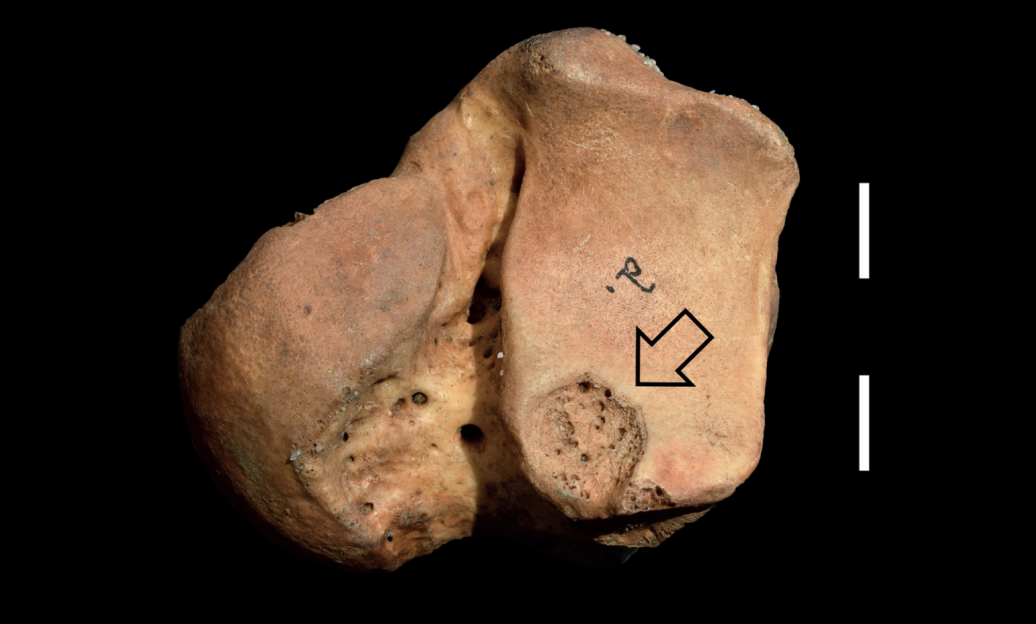 This arrow shows a lesion on part of the boy’s ankleCredit: Not known, clear with picture desk
This research was published in the Journal of Anthropological Science.