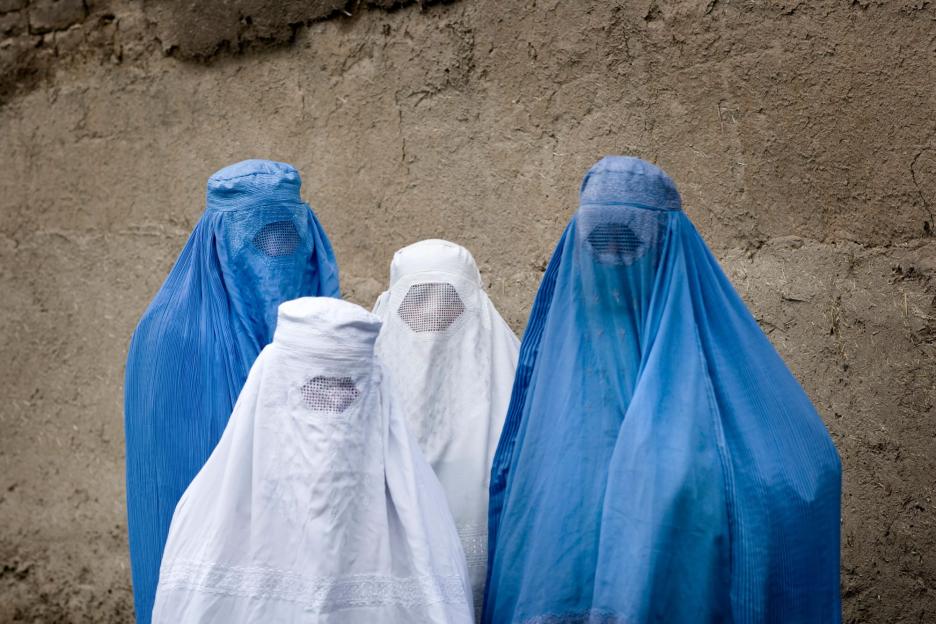
THE Taliban has legalised domestic violence in Afghanistan in what critics describe as a terrifying new assault on women’s rights.
Signed off by supreme leader Hibatullah Akhundzada, the new 90-page criminal code allows husbands to physically abuse their wives and children – so long as it does not result in “broken bones or open wounds”.
 The Taliban have granted husbands permission to physically abuse their wives and childrenCredit: Getty
 Abuse will be permitted as long as it doesn’t result in ‘broken bones’Credit: AFP
Drawing on Islamic scripture, the code sets out different levels of punishment depending on whether the offender is considered “free” or “a slave,” embedding inequality into the justice system itself.
Crucially, the Taliban has neither condemned nor explicitly prohibited psychological or sexual violence against women.
Those who breach the new rules face a maximum of just 15 days in prison.
However, this penalty is reserved only for cases involving “obscene force,” such as visible fractures or injuries.
The result, critics say, is near-total impunity.
Even when abuse crosses that threshold, convictions depend on the wife being able to prove it in court by showing her wounds to a judge.
This is a near-impossible task given that women are required to remain fully covered in public at all times.
To make matters worse, they must also attend court accompanied by a husband or male chaperone despite the fact that, in most cases, the abuser is the husband himself.
The same regulations allow a married woman to be jailed for up to three months if she visits relatives without seeking her husband’s permission even if she is seeking refuge from violence.
Most alarmingly, the law effectively classifies wives as the “property” of their husbands.
It also strips away previous safeguards, including the Elimination of Violence Against Women (EVAW).
Introduced in 2009 under the former US-backed regime, it brought in tough measures against forced marriage, rape and other forms of gender-based abuse.
Campaigners from the exiled human rights group Rawadari warn that the new penal code legitimises the “abuse, maltreatment, and punishment” of women and children, exposing them to “continued domestic violence.”
The group has demanded the “immediate halt of the implementation of the criminal procedure code” in Taliban courts.
It also urged the international community to “utilise all legal instruments” to prevent the law from taking effect.
Since regaining power in 2021, .
 The new penal code also fails to prohibit psychological and sexual abuseCredit: Getty
 Women in Afghanistan are forbidden from travelling to relatives to seek refuge from abuseCredit: AFP
Girls have been barred from education beyond the age of 12, and women have been excluded from many public spaces and workplaces.
UN Special Rapporteur on Violence against Women and Girls Reem Alsalem wrote on X: “The implications of this latest code for women and girls is simply terrifying.
“The Taliban however have understood, and understood correctly, that no one will stop them.
“Will the international community prove them wrong? And if so when?”
The new legal framework also signals further persecution of religious minorities.
It labels those who do not follow the Hanafi school of thought as “heretics.”
Approximately 15 per cent of Afghanistan’s 42 million people are not Hanafi Muslims – including Jafari Shias, Ismailis, followers of Ahl-e-Hadith, as well as Sikhs and Hindus.
Criticism of the code has quickly spread online, prompting the Taliban to issue a separate ruling stating that even discussing the new legislation constitutes an offence.
Shaharzad Akbar, Rawadari’s executive director, said the code places religious scholars in charge of enforcing sweeping restrictions while granting the clerics themselves broad immunity.
The system effectively institutes a caste hierarchy in which punishment is determined not by the severity of the crime, but by the social status of the accused.
At the top sit religious scholars, where if one commits a crime, they only receive “advice”.
“So the mullah is king now,” Akbar said.
“The mullah calls the shots, and the mullah gets all the privileges that ordinary people can’t, because they’re put even above elites.”
 The legislation repeals freedoms brought in under the previous US-backed regimeCredit: Getty
 Human Rights groups have been quick to denounce the new legal frameworkCredit: Getty
 Domestic abuse - how to get help
DOMESTIC abuse can affect anyone – including men – and does not always involve physical violence.
Here are some signs that you could be in an abusive relationship:
- Emotional abuse – Including being belittled, blamed for the abuse – gaslighting – being isolated from family and friends, having no control over your finances, what you where and who you speak to
- Threats and intimidation – Some partners might threaten to kill or hurt you, destroy your belongings, stalk or harass you
- Physical abuse – This can range from slapping or hitting to being shoved over, choked or bitten.
- Sexual abuse – Being touched in a way you do not want to be touched, hurt during sex, pressured into sex or forced to have sex when you do not consent.
If any of the above apply to you or a friend, you can call these numbers:
- The Freephone National Domestic Abuse Helpline, run by Refuge on 0808 2000 247 for free at any time, day or night
- Men who are being abused can call Respect Men’s Advice Line on 0808 8010 327 or ManKind on 0182 3334 244
- Those who identify as LGBT+ can ring Galop on 0800 999 5428
- If you are in immediate danger or fear for your life, always ring 999
Remember, you are not alone.
1 in 4 women and 1 in 7 men will experience domestic abuse over the course of their lifetime.
Every 30 seconds the police receive a call for help relating to domestic abuse.