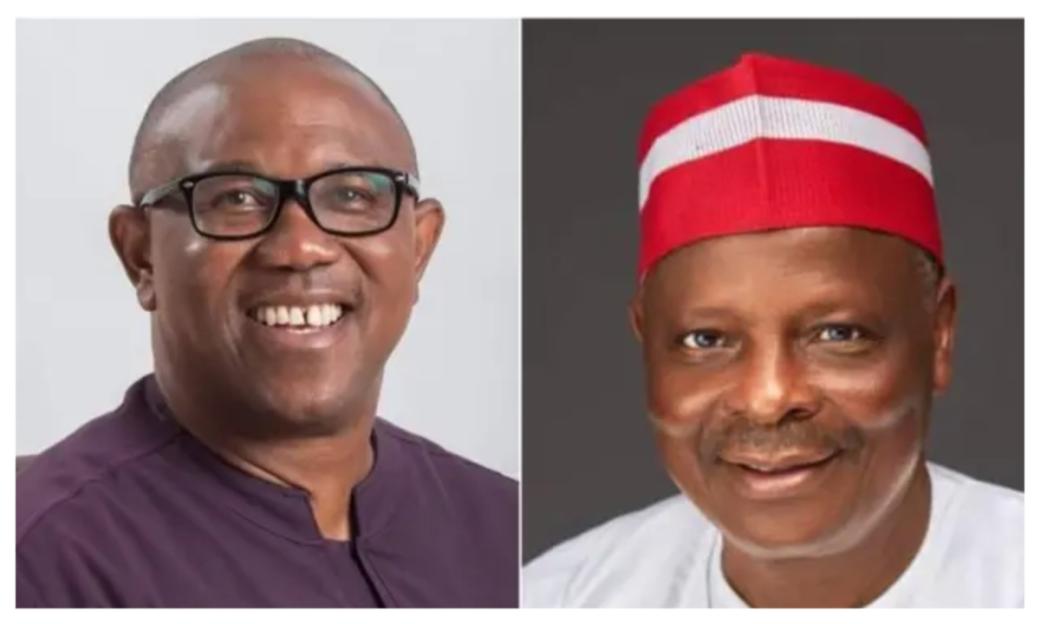
Nigerians are sharply divided over the political alignment involving Peter Obi and Rabiu Musa Kwankwaso under the Nigerian Democratic Congress (NDC), with reactions ranging from renewed hope to deep skepticism ahead of the 2027 general elections.
The development has triggered widespread debate across Nigeria and online, with citizens expressing mixed expectations about what the move means for opposition politics in the country.
While some Nigerians view the alignment as a potential breakthrough for opposition unity, others argue it reflects recurring instability within political coalitions.
At the centre of the development, Obi defended his decision, linking it to the worsening condition of the country.
“The condition of our nation and the urgent need to rescue Nigeria informed my decision to leave ADC for NDC,” he said.
He added that the decision followed deep reflection and was not driven by personal ambition.
“This decision was not made out of anger, personal ambition, or convenience. It came after deep reflection on the present condition of our nation,” he said.
Obi also cited internal crises and legal battles within opposition parties as part of his reason for leaving, noting that, “I left the ADC for the same reason I left the Labour Party: the severe, orchestrated litigation and internal crises…”
However, reactions from Nigerians suggest the explanation has not settled the debate.
Some supporters across social media maintained that loyalty to Obi remains unchanged regardless of party platform.
“You don’t need to be in the same party with Peter Obi to vote for Peter Obi… All you need is your PVC,” NDC North Star wrote on X.
“From LP to ADC to NDC, the mission never change, rescue this country,” Tell Another Bro said.
Others questioned the consistency of repeated political movements.
“If you keep changing parties, what exactly are you building?” Teejay 2 asked.
“Leaving a party over ‘internal crisis’ sounds valid… but isn’t crisis part of Nigerian politics everywhere?” Odunayo wrote.
Some Nigerians were more direct in their criticism of leadership credibility.
“Someone that can’t rescue ordinary LP or ADC from crisis,” Pragmatic DB said.
“You are not in any position to rescue the country because you could not rescue a small Anambra State,” Teejay 2 added.
Concerns were also raised that the development could mirror the fragmentation witnessed during the 2023 elections.
“Na the same way una enter 2023 elections lose you wan enter 2027?” Biodun Adeyanju wrote.
Beyond individual criticism, some Nigerians pointed to deeper structural issues in the political system.
But others disagreed, arguing that political change in Nigeria is driven more by individuals than institutions.
Even within opposition circles, the debate continues.
Former Labour Party vice-presidential candidate Yusuf Datti Baba-Ahmed questioned Obi’s decision to leave rather than fix internal challenges within the party.
“Someone who got the Labour Party’s ticket so easily should have stayed to fix the problem of the party no matter how difficult it is,” he said.
According to him, “If you are not ready to fight, stay in your house.”
Meanwhile, reactions also followed comments by Senate President Godswill Akpabio, who reportedly described the ADC as a “dying party.”
Some Nigerians disagreed with the framing of the comment.
“Dismissing opposition as ‘dying’ only weakens democracy… Healthy competition is what drives real progress,” a Niger State indigene who spoke under anonymity said.
Others dismissed it as routine political rhetoric.
Reactions from other Nigerians, who spoke to DAILY POST, also reflected mixed expectations about the unfolding political alignment.
Kingsley Moses, an Abuja-based youth, said the development could reshape opposition strength if properly managed.
“Honestly, this Obi–Kwankwaso talk makes sense. If they combine structure and credibility, it can shake things. Obi has youth and middle-class support, Kwankwaso has northern grassroots. This might finally be the balance we’ve been talking about,” he stated.
In Kano, Mal Bello Hamidu urged caution, stressing the importance of structure and mutual agreement:
“Kwankwaso is not a small politician. He has his own movement. This idea of him ‘joining’ anyone is where the problem is. It has to be partnership, not absorption.”
In the South-East, a trader, Amadi Chigozirim said trust remains, but expectations are high.
According to him, “People in this part of the country still trust Obi, but we are also watching closely. We don’t want promises again, we want results. If this new arrangement can bring stability and development, we will support it.”
An APC supporter, Aminu Sani, Bauchi state, dismissed the excitement around the alignment,
“People are overhyping this. Politics is not Twitter trends. Elections are won with structures, not sentiments. Let them come together first, managing ambition alone will scatter everything,” he stated.
A trader at the Minna market in Niger State, Madam Mary said her concern remains the economy rather than political arrangements.
He said, “My own is simple: will it reduce food prices? These politicians will always join and separate. If Obi and Kwankwaso can make things better for ordinary people, we will support them. If not, na the same story.”
In Lagos, a commercial driver in Oshodi said political movements no longer influence his daily concerns.
“All these political movements don’t move me again. Whether Obi or Kwankwaso, what I want is just one thing , let fuel and transport be affordable. If they can fix that, fine. If not, it’s the same cycle every time,” he noted.
Overall, the reactions highlight a divided public opinion, with some Nigerians hopeful that the alignment could strengthen the opposition, while others remain doubtful about its durability.