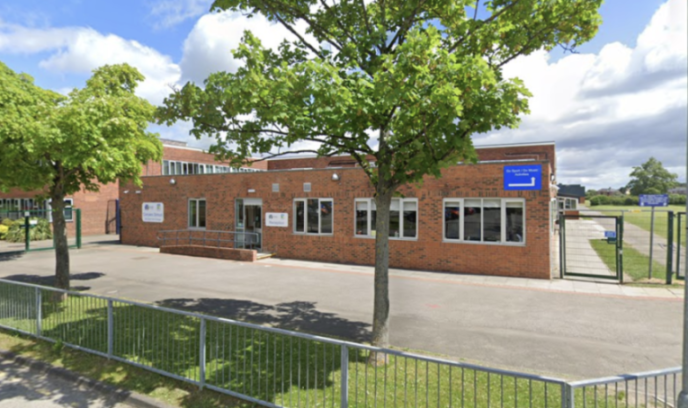
A SUSPECTED case of meningitis has been detected at a secondary school in a new town weeks after the deadly outbreak in Kent.
The alarm was raised yesterday after concerns were raised that a pupil at Conyers School and Sixth Form in Yarm, , had the infection.
 Conyers School staff acknowledged that the situation may be unsettling for parents and pupilsCredit: Google
UK Security Agency (UKHSA) officials have since urged the public to “remain aware.”
School staff acknowledged that the situation may be unsettling for families but said the risk to pupils remains low.
Normal routines will continue while assessments are carried out, the school said.
Chris Coleman, head teacher at Conyers School, said: “We understand this may be a concerning time for parents, staff and students connected to Conyers.
“We have been given assurances from the UK Health Security Agency that the risk to our students remains low and they should continue their normal activities.”
It follows a outbreak at the University of Kent that saw two students die.
Twenty cases of the disease have since been confirmed in the UK, with two currently being investigated, bringing the UKHSA’s current total up to 22.
A mutated new strain of bacteria is understood to be behind the Kent meningitis outbreak.
The UK Health Security Agency confirmed that the bug taken from hospitalised patients has not been seen before.
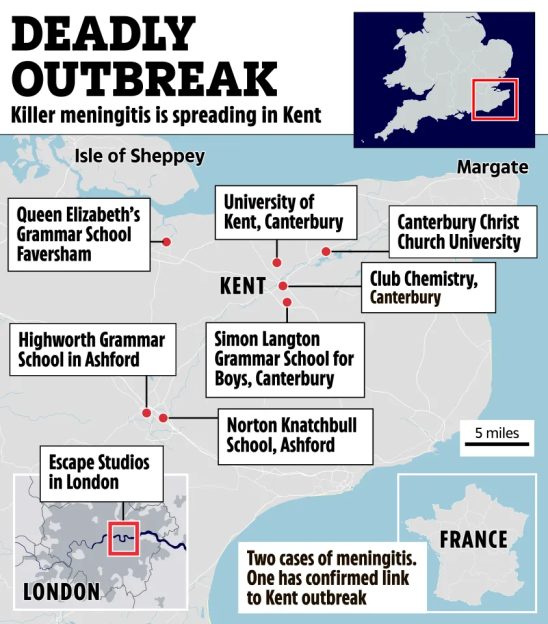
It is thought the outbreak in Kent was sparked by a “superspreader” event at the now closed Club Chemistry in Canterbury.
Why is meningitis B considered the most dangerous strain?
There are five main strains that cause the disease in the UK. But MenB is widely considered the most dangerous.
Health officials have said that at least some cases of meningitis seen in Kent have been confirmed as meningitis B.
Other strains include MenA, MenC, MenW and MenY, which are also caused by bacteria.
MenB is now the most common cause of bacterial meningitis in the UK, accounting for more than 80 per cent of invasive cases.
It is caused by Neisseria meningitidis group B bacteria and infects the protective membranes surrounding the brain and spinal cord, which can trigger life-threatening blood poisoning and brain inflammation.
The illness often develops suddenly, and early diagnosis is critical.
Dr Eliza Gil, a clinical lecturer at the London School of Hygiene & Tropical Medicine, said Neisseria meningitidis “can cause very aggressive infections”.
Professor Paul Hunter, an infectious diseases expert at the University of East Anglia, added: “The most important thing any friend or parent can do is realise the person may have this infection and seek medical help.
“Early treatment is vital, but diagnosis in the early hours of the illness can be very difficult.
“Early symptoms can be very mild but then deterioration can be extremely rapid leading to death within a few hours.
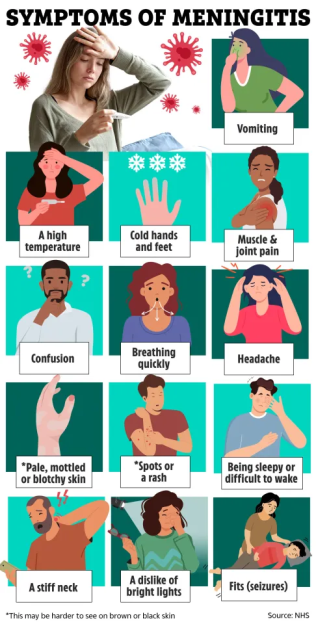
“Some of the warning signs include high fever, neck pain and stiffness, the light hurts their eyes, confusion and drowsiness and a particular skin rash that doesn’t blanch if a glass is pressed onto the skin.”
All but three of the patients hospitalised with the infection had visited the club in a three day period.
Cases of meningits B were confirmed at two , four in and one institution in .
The outbreak tragically saw the deaths of one Kent University student and a local grammar school sixth-form pupil.
An infant was also sadly hospitalised with the illness in London.
Experts raised fears that students carrying the disease could spread it across the country as .
More than 13,000 young people were given antibiotics to try and stop the spread of the bacteria.
And 10,000 were to protect against serious illness in the future.
Health chiefs have confirmed they are remaining “vigilant” to any further spread but warned that people must be alert to early signs of meningitis.
The total number of meningitis cases linked to Kent’s outbreak stabilised for the first time, figures revealed last Monday.
MENINGITIS OUTBREAK TIMELINE
March 5, 6 and 7
“Super-spreader event” as more than 2,000 revellers attend Club Chemistry across the weekend.
March 12
French authorities become aware of a case of meningitis in a student who attended University of Kent.
March 13
Medics at East Kent Hospitals NHS Trust alert local UKHSA branch of the first case of invasive meningitis.
March 14
UKHSA contact University of Kent.
French authorities finally alert UK health officials to the confirmed case in France.
Hospitals report a number of young adults with symptoms consistent with the disease and contact tracing begins.
March 15
Antibiotics are offered to those traced in connection with the outbreak and distribution begins in halls of residences with cases.
UKHSA stands up “full scale response” and schools with cases are identified
A public health alert is issued.
March 16
Club Chemistry highlighted as potential link to “invasive” spread
Two youngsters – 18-year-old sixth form student Juliette and a 21-year-old from the University of Kent – are confirmed to have died as a result of the outbreak.
Total of 13 cases
March 17
Health Secretary Wes Streeting says four cases of Meningitis B are confirmed and 11 are under investigation. All cases are linked to Kent.
Total of 15 cases
March 18
UKHSA says there are now nine confirmed cases, with strain in six cases confirmed to be MenB – 11 more being investigated but no further deaths.
Canterbury Christ Church University confirms meningitis case in a student.
Roughly 2,500 doses of antibiotics are given out and 5,000 students are offered vaccines.
Total of 20 cases
March 19
First confirmed case at a school in London, with four schools now affected in Kent. UKHSA says there are 15 confirmed and 12 cases still under investigation.
Total of 27 cases
March 20
The UKHSA says it had been notified of 18 confirmed and 11 probable cases of meningitis linked to Kent.
Health bosses warn the outbreak could spark “clusters” nationwide as students return home for the Easter break.
Total of 29 cases
March 21
Health officials confirm 23 laboratory cases and 11 reported cases remain under investigation.
Total of 34 cases
March 22
UKHSA confirms a drop in cases after some “confirmed” cases are downgraded following further tests.
Total of 29 cases
March 23
UKHSA says confirmed laboratory cases remain at 20 and 9 reported cases remain under investigation
Total of 29 cases