
NASA Unveils Stunning 'Time Travel' Image of the Most Distant Galaxy Ever Found, Dating Back Just 280 Million Years After the Big Bang!
NASA has hailed a mind-boggling image depicting the most distant galaxy we’ve ever seen. It was captured by the James Webb Space Telescope, allowing you to star...
 Written byEze Chidiebere Paul
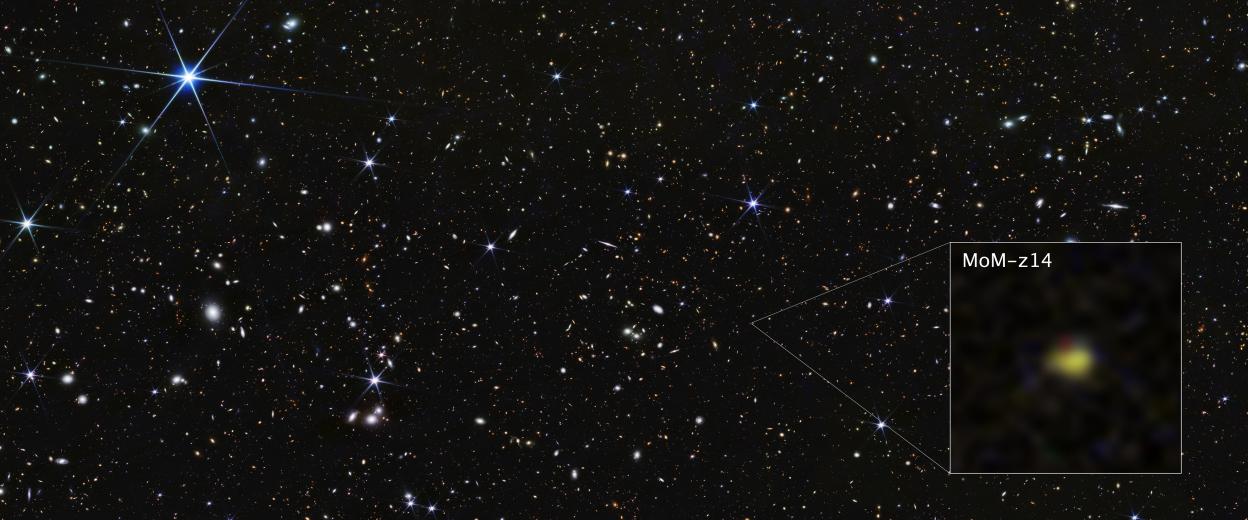
NASA has hailed a mind-boggling image depicting the most distant galaxy we’ve ever seen.
It was captured by the James Webb Space Telescope, allowing you to stare back in time closer than ever to the Big Bang.
This stunning image lets us peer far back in time
The galaxy is called MoM-z14, and was pictured in April last year.
Scientists revealed the discovery in 2025, but the research has now finally been peer-reviewed and published in a journal, with confirming the discovery in a new statement.
Now Nasa says the image pushes the “boundaries of the observable universe” even closer to the Big Bang.
“With Webb, we are able to see farther than humans ever have before,” said lead author Rohan Naidu, of the Massachusetts Institute of Technology.
“And it looks nothing like what we predicted, which is both challenging and exciting.”
Viewing extremely distant galaxies has huge benefits for scientists looking to probe the origins of the universe.
That’s because it takes time for light to travel.
To our eyes it’s usually imperceptible, because light travels so extremely quickly, you don’t notice it when looking at every day objects.
But it takes just over a second for light from the Moon’s face to reach our eyes, and about eight minutes for it to arrive from the Sun.
That means when you look at the Sun, you’re actually seeing it as it was eight minutes ago.
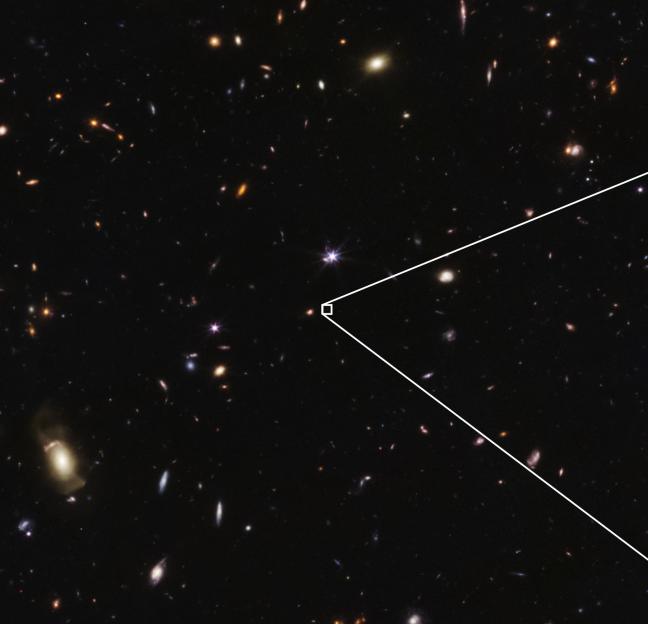 Nasa spotted the galaxy deep in the far reaches of space at the limits of our observable universeCredit: Image: NASA, ESA, CSA, STScI, Rohan Naidu (MIT); Image Processing: Joseph DePasquale (STScI)
When you scale this up to vast cosmic levels, you can see right back to the earliest moments of the universe.
MoM-z14 is so immensely distant that viewing it is effectively .
And the imaging of MoM-z14 means we’re able to see the galaxy as it was just 280 million years after the Big Bang, which took place 13.8 billion years ago.
The situation is made more complex by the fact that the universe is expanding, which makes working out distances and time slightly trickier.
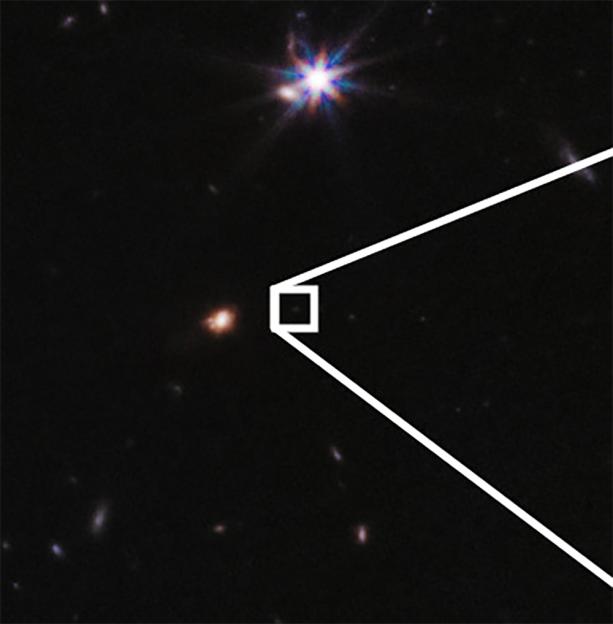 The incredibly imaging was captured by the James Webb Space TelescopeCredit: Image: NASA, ESA, CSA, STScI, Rohan Naidu (MIT); Image Processing: Joseph DePasquale (STScI)
But Nasa says it was able to pinpoint the rough age of the galaxy to an exceptionally early 13.5 billion years ago.
“Due to the expansion of the universe that is driven by dark energy, discussion of physical distances and ‘years ago’ becomes tricky when looking this far,” Nasa explained.
“Using Webb’s NIRSpec (Near-Infrared Spectrograph) instrument, astronomers confirmed that MoM-z14 has a cosmological redshift of 14.44.
“Meaning that its light has been travelling through (expanding) space, being stretched and “shifted” to longer, redder wavelengths, for about 13.5 of the universe’s estimated 13.8 billion years of existence.”
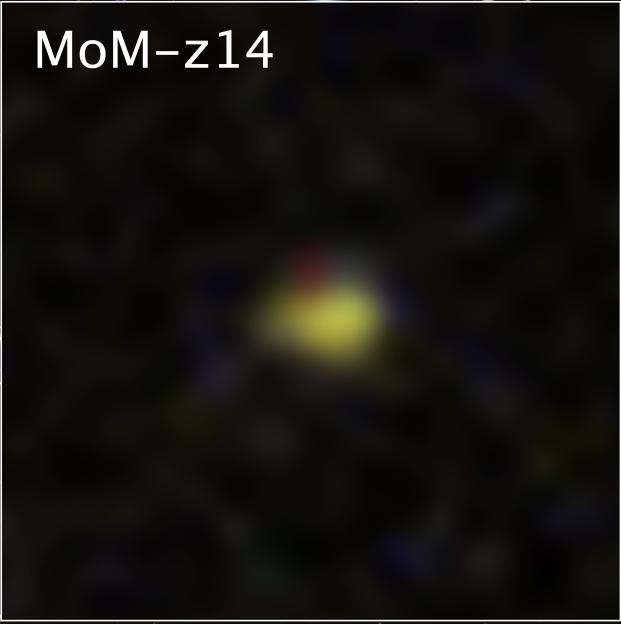 It’s not much to look at like this – but this image shows a moment not long after the Big BangCredit: Image: NASA, ESA, CSA, STScI, Rohan Naidu (MIT); Image Processing: Joseph DePasquale (STScI)
Nasa says that MoM-z14 is one of a group of surprisingly bright galaxies in the early universe.
And it has unusually high amounts of nitrogen, the scientists were able to reveal.
“We can take a page from archeology and look at these ancient stars in our own galaxy like fossils from the early universe,” Naidu explained.
“Except in astronomy we are lucky enough to have seeing so far that we also have direct information about galaxies during that time.
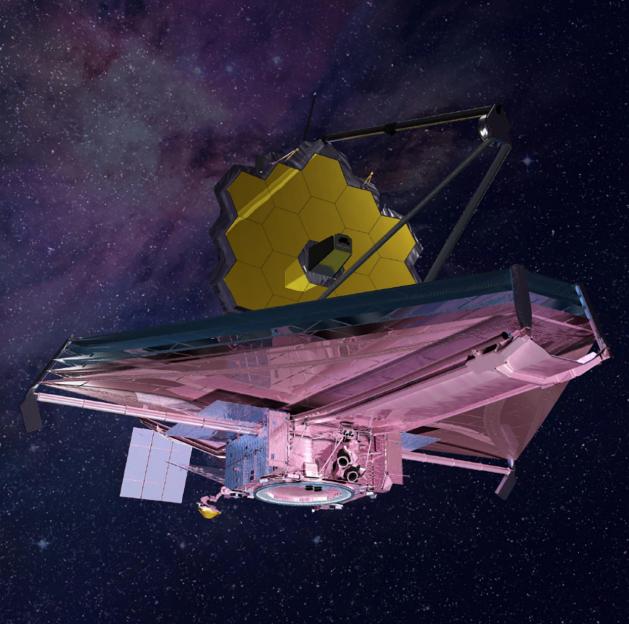 The James Webb Space Telescope launched back in 2021 and has captured incredible imagesCredit: Nasa
“It turns out we are seeing some of the same features, like this unusual nitrogen enrichment.”
There shouldn’t have been enough time for generations of stars to produce high amounts of nitrogen in the 280 million years between the Big Bang and the moment captured by the image.
So researchers think that the density of the early universe led to supermassive stars that were capable of producing more nitrogen than stars we see in the local universe.
Nasa hopes to peer back even farther in time using Webb and the upcoming Nancy Grace Roman Space Telescope, which is expected to launch as early as late 2026.
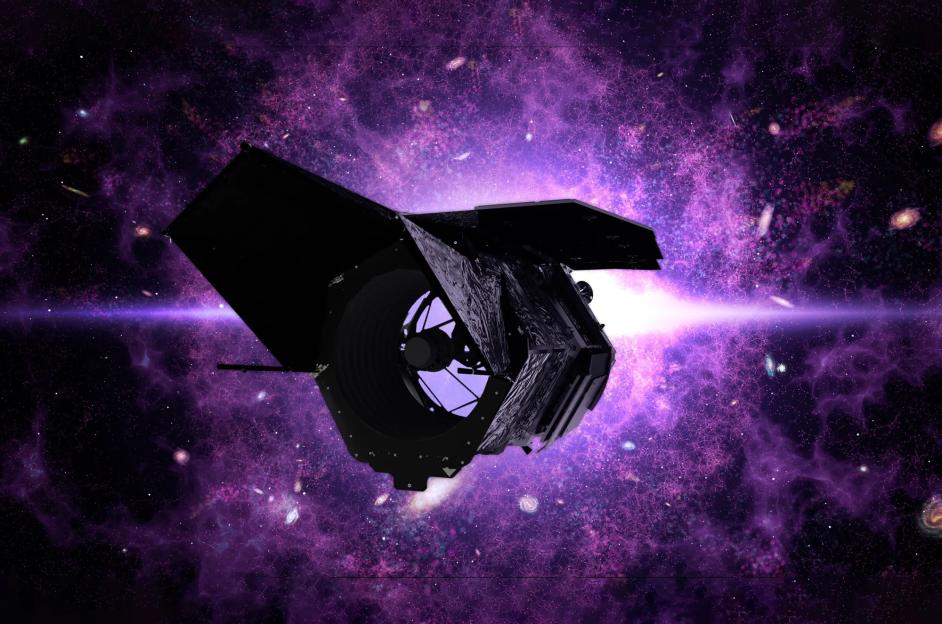 The Nancy Grace Roman Space Telescope, which could launch later this year, is expected to further survey the cosmos and its mysteriesCredit: Nasa
“To figure out what is going on in the early universe, we really need more information,” said research team member Yijia Li, of Pennsylvania State University.
“More detailed observations with Webb, and more galaxies to see where the common features are, which Roman will be able to provide.
“It’s an incredibly exciting time, with Webb revealing the like never before.
“And showing us how much there still is to discover.”
Sign up for The Sun Tech newsletter for gadgets, games & more
Hello! I'm Sean Keach, The Sun's Head of Technology and Science
I’ve been writing about gadgets, games and the future of technology for more than a decade.
During that time I’ve penned thousands of articles, filmed hundreds of videos, talked tech on TV and radio, and travelled around the world to bring you the latest on Apple, Meta, Google, Amazon, Netflix and more.
And I’ve got a weekly newsletter called The Sun Tech that you can read for free every Thursday.
I bring you the latest from the world of tech, including behind-the-scenes action, exclusive content, expert analysis, and plenty of help advice – so please follow along!
This research was published in the Open Journal of Astrophysics after peer-review.
Continue reading

Infinix Launches GT 50 Pro: The Ultimate Hardcore Gaming Flagship with Industry-First Cooling and Control
Driven by a breakthrough thermal engine, the Infinix GT 50 Pro harmonizes physical precision, flagship hardware, and software intelligence to transform a mobile...

Infinix GT 50 Pro Set to Make Nigerian Debut at PMNC Nigeria Finals on September 12
For competitive gamers, the wait is almost over. Infinix has confirmed September 12 as the Nigerian debut of its new GT 50 Pro gaming smartphone, with the launc...

iOS 27 Release Date: What to Expect in Features and Compatible Devices!
APPLE has unveiled its flagship iPhone 18 Pro and foldable iPhone Duo. But one of the biggest upgrades coming to your pocket is the software running under the h...

3,000-Year-Old Mystery of Egypt's 'Screaming Mummy' Solved: Death Frozen in Terror Unraveled!
SCIENTISTS may have finally unravelled the mystery behind the death of an Egyptian mummy after 3,000 years. The female corpse known as the “screaming woman” was...