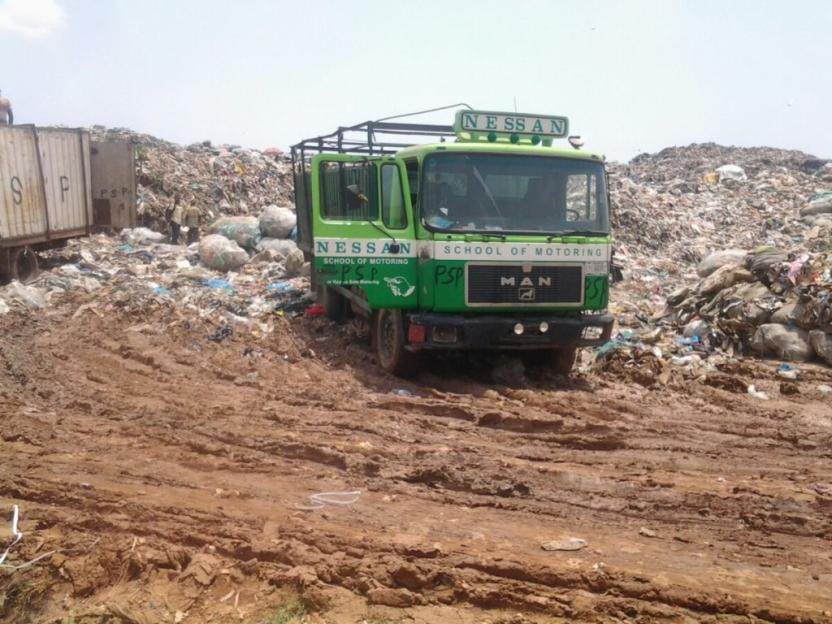
Lagos, the commercial hub of Nigeria and arguably, the fastest growing
city in the world, is faced with lots of environmental pollution, ranging from vehicle emission, and waste dumpsites emission to generator emission as well as industrial pollution.
DAILY POST reports that along the major roads in Lagos, people dump refuse indiscriminately, creating an eyesore in most of the spots.
For instance, along Oshodi-Apapa Road, the sight of indiscriminate refuse dumps is commonplace. It is the same scenario along Mile 2-Badagry Road, particularly at Iyana-Oba Market where the stench hits passers-by.
Among all the agents of air pollution, waste dumpsites pose greater
threats to the health of Lagosians. For instance, residents of Igando
community in Alimosho Local Government Area of Lagos State crying blue
murder over the existence of multiple refuse dumpsites in their
environments. They are crying to the authorities about the looming
health danger that the community is exposed to if urgent steps are
not taken to address the situation.
For those travelling to Lagos for the first time, approaching Ojota is
an experience that puts one off. The stench from the Ojota dumpsite
travels miles away. Residents Ojota in Kposofe Local Government Area,
Ikosi Isheri and even Agboyi-Ketu and the surrounding neighbourhoods
are not finding it easy as they battle with the stench from the
dumpsite on a daily basis.
The Igando residents are particularly complaining that the two major
dumpsites, Solus 3 and Bola are giving them nightmares.
Solus 3 is located near the Igando General Hospital, while Bola is at Lanre
bus-stop. Although the refuse disposal trucks are always parked
signifying readiness to clear the refuse regularly, the stench from
the two waste sites is still unbearable to residents.
When our reporter visited the surrounding communities, residents
poured out their hearts in lamentation. They said they were helpless
as the odour continued to torment them every second of the day.
From the observation of our reporter, the entire area along
Isheri-LASU Road, stretching over three bus-stops, is under serious
threat of air pollution. The stench from the dumpsites, located over
200 metres from the road, pervades the entire area.
While passersby try to cover their noses with their palms to stave off the odour or to lessen its impact, some people are comfortably seated around the area doing one business or the other. Such people as vulcanizers,
transporters, food vendors, sachet water sellers, okada riders as well
as those who sell mineral water and biscuits among others, carry on
with their businesses in a supposedly relaxed mood as if all is well.
However, the same cannot be said of a stranger or a visitor,
especially those going to the area for the first time. They are
easily noticed because it is either they are frowning and pouting or
they are struggling to cover their noses with handkerchiefs or their
palm, while they increase their pace in order to escape from the
scene.
Unfortunately, escaping from the scene is not very easy because the distance is a bit long. That is for those who do business along the
road and those who pass by. For those who live around the dumpsites,
life has become tough and uninteresting as they live at the mercy of
the offensive odour that the sites emit all through the day.
Aside from the stench from the dumpsites, it was also discovered that the entire vicinity has been invaded by various kinds of houseflies.
All the restaurants and beer parlours around the place are in constant
battle with flies. It is either the operators are spraying kerosene
around the floor and on their tables or they are applying other
chemicals to disinfect the environment and possibly drive away the
flies that have become a big source of embarrassment to them before
their customers.
However, checks by our reporters revealed that the customers no longer
complain about the flies; they have accepted them as inseparable and
an integral part of drinking and pepper soup joints as well as
restaurants in the area.
A customer, who was observant enough to notice the surprises on the faces of our reporter, politely said to him: “Please, young man, don’t mind the flies. In this area, that is how we see it and there is nothing anybody can do about it so long as these dumpsites remain with us here.
“In fact, if you go to any beer parlour or restaurant around this area and you don’t find flies, then something is wrong and I would advise you to run away from such a place. Even if a fly enters into our cups of beer and dies or into our plates of soup, it doesn’t mean anything; we cannot throw such soup or beer away because of that.
“I believe that God has a way of protecting us in this area because
all the germs from the flies no longer have any negative effect on our
system. We are so used to the flies such that our body systems are
already immune to any kind of bacteria they may carry.”
When our reporter visited one of the Solus 3 dumpsites, residents expressed their feelings about the situation, describing it as unbearable.
To capture the condition of the residents, a school proprietor, Temitope Ogunsola said they had been abandoned to their fate as all efforts to get the state government’s attention to their pitiable plight have not yielded any positive result. He insisted that the estate was approved by the state
government and wondered why the same government would approve the
existence of waste dumpsites where human beings live.
“We have tried our best regarding this problem. We have written series
of letters to the state government through the ministry of environment
and we were promised that the community would be fumigated by Lagos
Waste Management Agency (LAWMA) officials. But that has not happened,” he said.
Describing the odour as unbearable, Ogunsola said: “When it rains, it
becomes worse because the refuse and contaminated water from the
dumpsite would be flushed down by rain water and the entire road would
be blocked, rendering it impassable. No vehicle would be able to
access the road. It even becomes difficult for pedestrians to walk
through because the whole place would be covered by dirt and the
stench would rise to high heaven. Only those who could tiptoe or
frog-jump, would be able to pass through at such times.”
Beside rendering the street that links the estate with the Isheri-Lasu
Road impassable when it rains, it also brings about serious flooding
to residents of Odubanjo area, he informed, adding that people can
hardly stay outside their houses for two minutes due to the odour.
“Also at the express road, nobody can stay at the bus-stop to board a
bus when it rains because of the odour,” he added.
Asked what the residents are doing to minimise the odour, he said: “We
invite private firms from time to time to fumigate people’s houses.
That only provides temporary relief as the odour normally abates after
each round of fumigation. But unfortunately, it can only last for two
or three days. However, such services from private fumigation firms
are only available to those who can afford them. Those who cannot
afford such services do not have any alternative but to keep inhaling
the polluted air, at their own health risk.”
Checks confirmed fears in some quarters that residents might face
possible cholera outbreak as the dumpsites are capable of
contaminating the water they drink.
But Ogunsola dismissed such concerns, although he agreed that such might be possible in future.
He said: “We are lucky that the refuse dumpsite has not affected the
water we drink. The state government came down here sometime in the
past to test the borehole water it provided for us, to know whether it
is good for drinking. After the test, the water was certified safe.
There are about 10 of such boreholes. So, for now, it has not affected
the water we drink but that is a possibility in future and we don’t want that future to catch us napping. That is why we are calling on the state government to do something before it becomes late.”
However, against the rumour in some quarters that the estate around
Solus 3 dumpsite was not mapped out as a residential area, he said: “I want to tell you that some people have been living here before the dumpsite came. People had built houses here and were already living before the dumpsite.
“Initially, it was the ‘Omonile’ that were collecting money from people to dump their refuse before the state government officially declared the place a dumpsite.”
He lamented that the odour has caused a lot of damage to the residents of the area, especially the landlords, economically and health-wise.
“The odour is affecting us in so many ways,” he said. “It is only the landlords that are living here. The odour scares potential tenants away and even tenants that rented houses here in the past are leaving in droves.
“No educated person would want to live here as a tenant. It is just landlords like us who have no other place to go that are suffering this environmental pollution.”
He lamented that refuse from every part of the state is dumped there without considering the health implications on the residents.
“The refuse from all over the state is dumped here. Trucks from all over Lagos, such as the ones from Agege, Iyana Ipaja, Aja, Ikoyi, Mushin, Oshodi, Abule-Egba, Ejigbo, Egbeda, Ikotun and Ijegun among others dispose refuse at Solus 3,” he said.
The story of refuse dumpsites in the Igando area presents different
options to different people. While some are calling on the state government to close down the dumpsites and look elsewhere, some others think otherwise.
Those who share such sentiments, though equally feeling the heat of the stench, would resist any attempt to close down the dumpsites. Their businesses are patronised by the workers in those sites, and closing down the dumpsites amounts to running them out of business.
One of such people is a woman known as Iya Taiwo, who runs a restaurant around one of the dumpsites.
She said in Pidgin English: “I no like the odour but the workers at the dumpsite are my customers. So, I no go like make government close the place because e go affect my business. The odour no dey affect my customers because na them dey work there.”
Efforts by our reporters to make her understand that her health is
more important than her business didn’t make any impact.
She insisted that if she falls sick as a result of the odour, she could use part of the proceeds of her business to treat herself.
Another businesswoman, who gave her name as Rose, condemned the idea of dumpsites around residential areas, describing such sites as a reservoir for mosquitoes.
She said: “This dumpsite is called Bola; it is exactly by the Lanre bus-stop. The odour is something else; it is too much, especially when it rains. We have complained severally through the landlords’ association but nothing has happened.
Aside from the offensive odour, it also increases the number of mosquitoes when it rains. In fact, once it rains, mosquitoes would be breeding in millions and you know what that means to human beings. So, we want the government to help us because the odour is too much. It is killing us.”
However, a new health angle was introduced when a resident who
wouldn’t want her name in print revealed that the odour had deadened
the olfactory lobes of many residents, noting that they no longer
perceive the odour as offensive.
She said: “It has become part of us because we are already used to it.
It is from the passersby that we remember the odour. In other words,
we perceive the odour but not as strong as the passersby. I believe it
has affected our sense of smell so much that they are no longer
active.”
She said the odour diminishes during the dry season.
“The dry season is just like the Christmas period for us, because as soon as we enter into the rainy season, the rains would bring out the dirt and splash everywhere. It is such a nightmare to stay around this area during the rainy season.
“In fact, I don’t think you would have been able to stay here and talk to me as you are now doing if the rainy season had properly taken off. My brother, it is too bad,” he lamented.
People living around the Bola dumpsite at Lanre Bus Stop are even
experiencing more woes than those around Solus 3.
A resident told this reporter: “Another thing is that it affects some people’s boreholes. The colour of the water from the borehole is orange. If you use it on any stainless plate or cup, it will become rusty.
“Although some people have good water from their boreholes, almost all the residents behind this Bola dumpsite have water problems because of this dumpsite.
“This offensive odour travels for some kilometres. For instance, my residential house is far away from here but when it rains, we are not left out. The odour still gets to us.”
Describing the situation as death by instalment, another resident,
Christian Ewuga appealed to the state government to look into the
matter and avert the looming danger.
“It is a terrible situation and we are calling on the state government, as a matter of urgency, come to our rescue. We are dying by installment.
“Many people have fallen sick due to the polluted air. Nobody may know the cause of such people’s ailment because it has not degenerated to a full epidemic, but I can tell you that it is the air they breathe here,” he noted.
The residents believe that if the government could close down the sites, it would do a whole lot of good to them.
“The problem is multi-faceted and we are urging the state government to close down the site to save residents from the possible outbreak of diseases,” they said.
A patient at the Igando General Hospital, who introduced himself as
Wale, described the situation as unacceptable.
“We are helpless; the odour has become part of our lives. We no longer complain because such complaints have never produced any positive result.
“We have resigned ourselves to fate. How can anybody think of locating refuse sites of such a magnitude near a residential area. How can one explain the fact that a government’s General Hospital which handles different health challenges is located a stone’s throw from such a site.
“It is as ironical as it is unacceptable and the state government must rise to
the occasion and do something urgently. If the government is actually
about the welfare of the people, then the state governor must act fast
to avert the impending doom,” he said.
However, efforts to get the Lagos Waste Management Agency, LAWMA’sn comments on the development failed, as several calls to its General Manager did not get through.
A text message sent to the LAWMA GM’s phone number was not replied.