A MUM who began feeling hot and weak during an emergency C-section lost over five litres of blood and had to be put into a coma after doctors found a blood clot on her cervix.
Sarah Mills, 32, said she “repeatedly” told doctors that something was wrong, saying she thought she was “going to heaven”.
 Sarah Mills pictured with her partner Marius lost five litres of blood during an emergency C-section Credit: SWNS
 Her daughter Myla was born healthily, but the mum was put into a coma shortly afterwards Credit: SWNS
She said: “I genuinely thought I had died and been brought back to life.”
Doctors eventually put the mum, from Harringay, London, under general anaesthetic and found a blood clot on her cervix.
But when they removed it she lost 5.5 litres of blood.
Sarah said: “If they had listened to me when I said something was wrong, they would have found the bleed much sooner.”
 As soon as Sarah’s daughter was born, she said she felt hot and weak and was eventually given a general anaesthetic Credit: SWNS
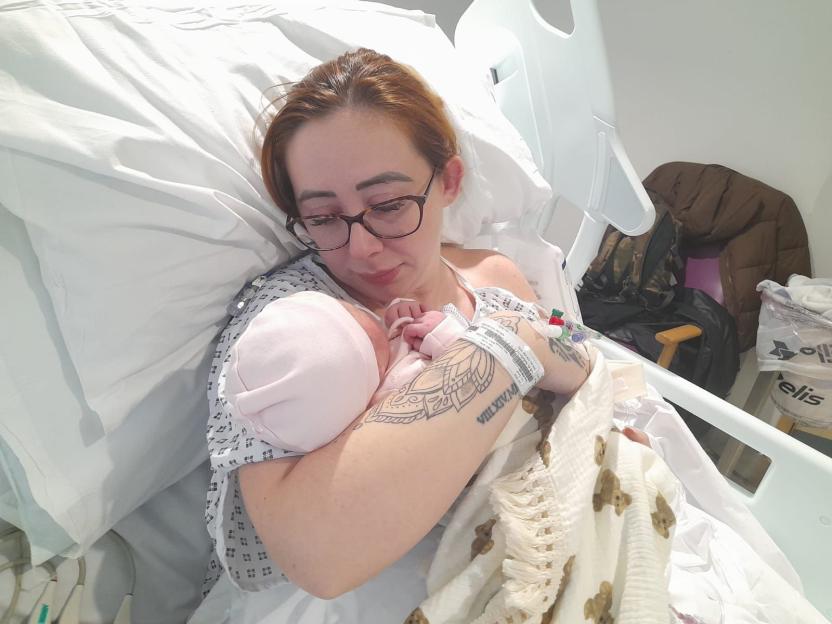 Doctors found a blood clot in the mum’s cervix and when they removed it she lost a lot of blood Credit: SWNS
The school administrator and her partner Marius, 35, found out they were expecting in February 2025 and were later told they were having a girl.
Sarah explained that her son Tyler, 10, was born by C-section, but that medics at Harringay hospital had cleared her for a vaginal birth.
She experienced a week of sporadic contractions and decided to visit a hospital midwife on 22 October.
The mum was told that her cervix was too far back for a vaginal sweep so she was offered an induction at 40 weeks and five days pregnant.
Five cervical rods were inserted the next day, 23 October, and Sarah’s contractions came every 30 minutes.
Cervical rods absorb all the fluid around the cervix and cause it to open, in a process called non-hormonal induction.
Induction is common if your baby is overdue or there’s a potential risk to you or the baby’s .
There are two main ways to induce labour – by putting hormones inside your vagina using a “vaginal tablet” or a gel, or by a device such as a balloon catheter being used to widen your cervix.
Sarah said: “It was extremely traumatic from the induction onwards.
“The contractions were excruciating. I couldn’t understand why they were so painful.
“I can’t understand why the level of inductions and emergency c-sections is so high at the moment.”
According to a report in the BMJ last September, more than half of births in Great Britain now have a medical intervention by induction or C-section.
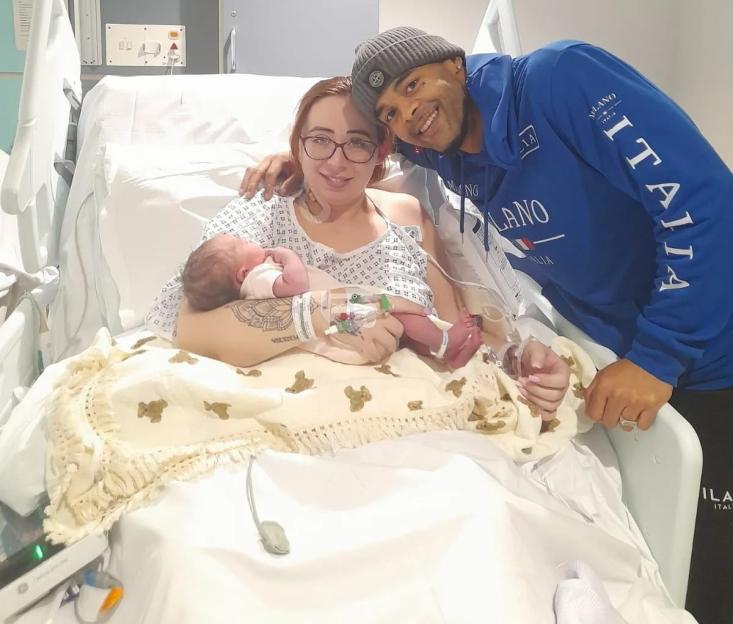 Sarah said that the entire birth process was extremely traumatic Credit: SWNS
 Myla’s hand had passed through Sarah’s cervix while she was in labour and doctors said she needed an emergency C-section Credit: SWNS
By 11am the next morning, 24 October, Sarah’s contractions were happening every two and a half minutes, and she was 2.5cm dilated.
Midwives broke her waters at 3pm, but when they noticed that the waters were stained, they said she would need to be continuously monitored to ensure Myla – her baby – was okay.
By 5pm a midwife noticed that Myla’s hand was above her head and two hours later they discovered it had passed through the cervix so far that doctors couldn’t push it back.
Sarah was told she would need an emergency C-section and Myla was born at 8:21pm weighing 8lbs.
But from the moment her daughter was born, the mum said she began to feel hot and weak.
She said: “This was the most frightening thing that has ever happened to me.
“In theatre I kept saying something is really wrong.
“I saw a really bright white light and kept telling them I was going to heaven.”
The mum continued: “When they were stitching me up I felt my whole body draining, it was very very frightening.
“I felt I had to keep my eyes open or I was sure I would die.
“I focused on the squares in the ceiling, but they kept getting bigger and smaller.”
Sarah was given a general anaesthetic when she began to feel the needle pricking her skin.
While she was asleep, a blood clot was found in her cervix and when it was removed, she began to bleed profusely.
The mum was given seven blood transfusions and lost 5.5 litres of blood.
At 1am on 25 October, Sarah’s partner Marius was told that the bleeding was under control and that she had been put in a coma.
The mum awoke in the morning but had to wait until 6pm to be wheeled down to the birth room to see her daughter.
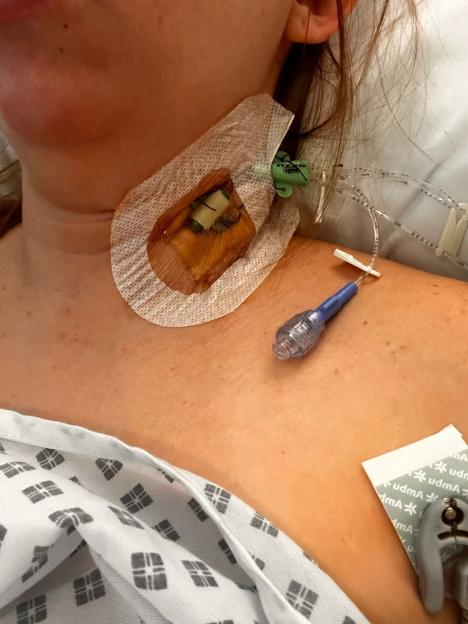 The mum was given seven blood transfusions after doctors discovered the blood clot Credit: SWNS
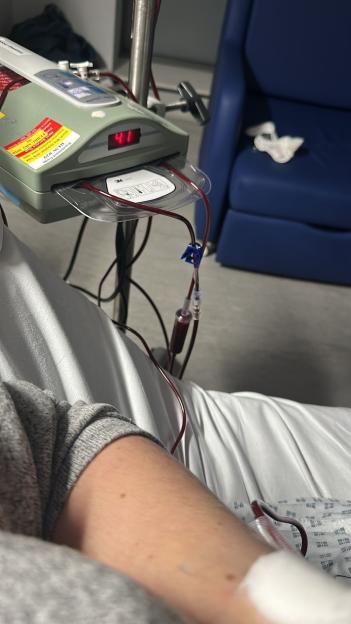 Doctors eventually got the bleeding under control but at this point Sarah was in a coma Credit: SWNS
She said: “It was just so emotional when I saw Myla again.
“Mum passed her to me, and I just cried.
“Everyone else had spent time with her, but I’d only seen her briefly when she was just born.
“I couldn’t believe I’d been so close to never seeing her again.”
Sarah and Myla had to stay in hospital for a few days and got to go home together on 29 October.
At a meeting about the birth, doctors explained that the bleed was caused by the pressure of Myla’s head on Sarah’s cervix and the speed at which they needed to pull Myla out.
Sarah said: “If they had listened to me when I said something was wrong, they would have found the bleed much sooner.
“Women know our bodies, and we need to be heard.
“I know they’re really busy and overstretched, but it’s really important to listen and respond compassionately.”
In a letter sent to Sarah from Royal Free London Foundation Trust, the trust acknowledged “the significant psychological impact” of the events in the operating theatre and said they are “very sorry for the trauma you experienced before your condition was fully stabilised.”
 Sarah and Myla had to stay in hospital for a few days after the mum’s ordeal Credit: SWNS
 What you need to know about inducing labour
It’s common for labour to be induced if your baby is overdue or there’s any risk to you or your baby’s health. This risk could be if you have a health condition such as high blood pressure, for example, or your baby is not growing.
Induction will usually be planned in advance. You’ll be able to discuss the advantages and disadvantages with your doctor and midwife, and find out why they think your labour should be induced.
It’s your choice whether to have your labour induced or not.
How labour is induced – there are two main ways:
- Hormones can be put inside your vagina using a vaginal tablet (pessary) or a gel, or given as tablets that you swallow
- Devices such as balloon catheter (a small balloon, full of water) or an osmotic dilator (a type of sponge) can be used to widen your cervix
- You’ll usually be offered hormones first to see if they work, unless there’s a medical reason you cannot take hormones
- It usually takes many hours for these treatments to start working. You will usually stay in the hospital maternity unit, though you may be able to go home in some cases
- Sometimes a hormone drip is needed to speed up the labour. You may also need to have your waters broken artificially
Source: NHS
In the letter, Director of Nursing Matthew Hodson said: “I hope that you will accept my personal apologies for your experience at North Middlesex University Hospital.”
A spokesperson from the Royal Free London said: “Due to patient confidentiality, we are unable to comment on the care of individual patients.
“We have received a complaint from Ms Mills and are sorry to hear of her concerns. We are looking into the care provided and will share our findings with her in due course.”