FOOTBALL might have seen a glimpse into its future after the “daylight” offside rule was implemented for the first time.
The brainchild of legendary boss , this new interpretation of the offside law dictates there needs to be a complete gap between the attacker and the second-to-last opposition player for there to be an offence.
First ever goal from Wenger's 'Daylight' rule being trialed in the Canadian Premier League. Interesting one. Video courtesy of OneSoccer/Canadian Premier League. pic.twitter.com/MeXNft04JJ
— Simon Evans (@sgevans) April 18, 2026
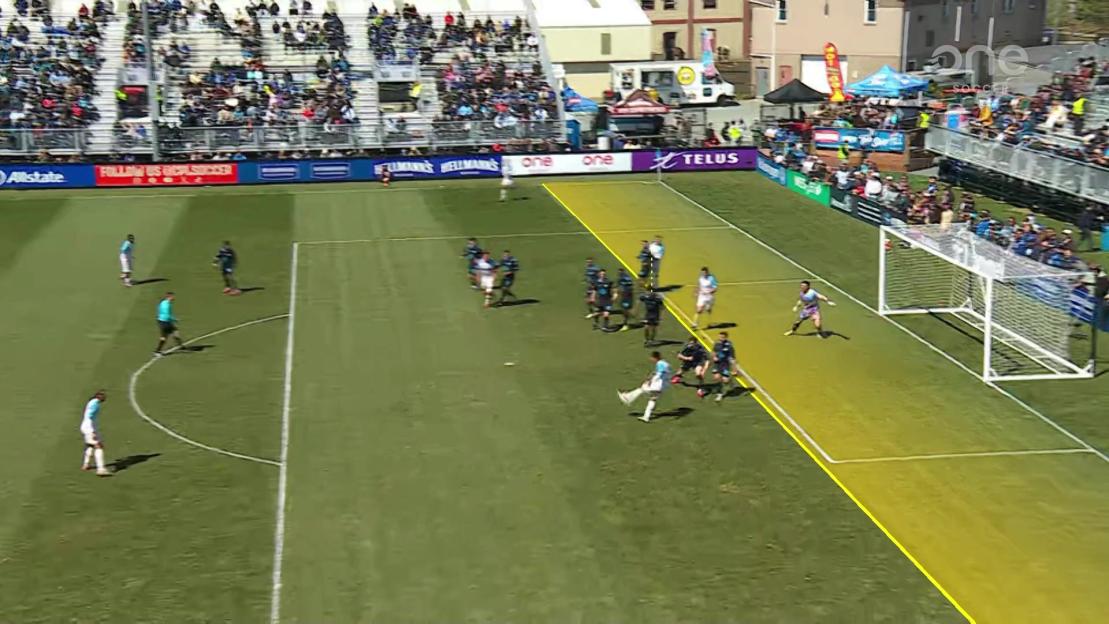 Arsene Wenger’s historic ‘daylight’ offside rule has been implemented for the first time Credit: One Soccer
 Pacific FC ace Alejandro Diaz was ruled to not be in an offside position under the new law Credit: One Soccer
The Canadian Premier League is the location where the new rule is being trialled in cooperation with .
And Pacific FC ace Alejandro Diaz became the first player to benefit from it as he scored against Halifax Wanderers in a 2-2 draw.
Under the rules widely used by lawmakers, Ifab, Diaz would have been considered to be in an offside position as he tucked home a rebound following a team-mate’s shot being saved by the goalkeeper.
However, under the Wenger rule, Diaz’s position, with only some of his body beyond the last defender, was ruled to be onside due to there not being any clear “daylight” between himself and the defender.
Wenger, who is Fifa’s Chief of Global Football Development, first proposed the law in 2020.
When the trial in the CPL was , the 76-year-old said: “This is an important pilot.
“By testing this new interpretation in a professional competition, we can better understand its impact, including in terms of improving clarity and the flow of the game and promoting attacking play.
“We look forward to analysing the results of the trial phase.
“We thank the Canadian Premier League and the Canadian Soccer Association for their willingness to support Fifa with this pilot and for providing their competition.”
Critics of the new law argue it gives too much of an advantage to the attacking team, and could therefore have the opposite intended effect by making teams drop deeper into an even more defensive posture.
Results of the trial will be presented to Ifab at the end of the year.
If successful, there is a chance the law could be widely introduced by the start of the 2027-28 European season.