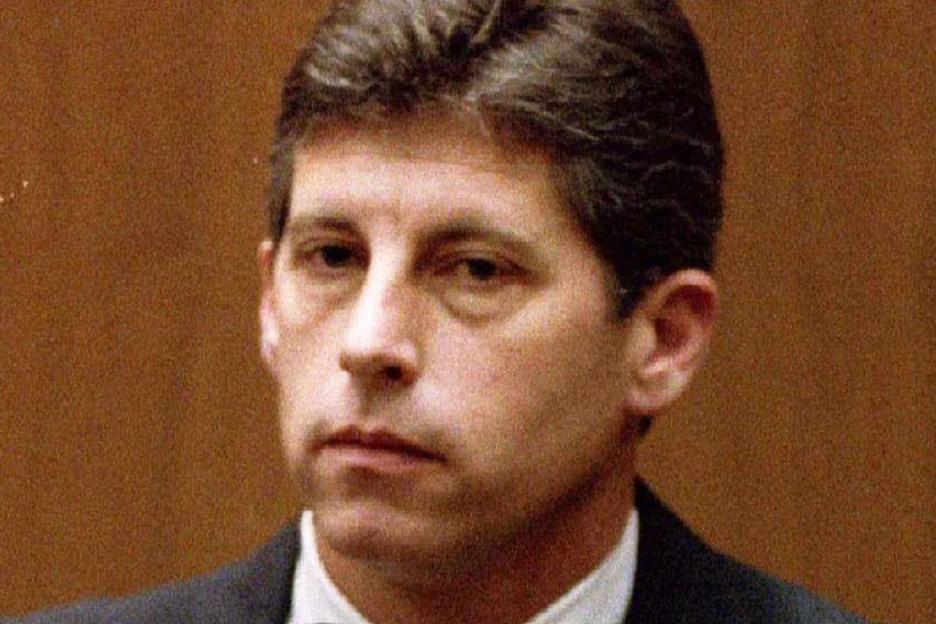
DISGRACED former LAPD detective Mark Fuhrman – the officer who discovered the infamous bloody glove in the O.J. Simpson murder trial – has died aged 74.
Fuhrman died on May 12 after battling an aggressive form of throat cancer.
 Disgraced former LAPD detective Mark Furhman has died aged 74 Credit: Reuters
 Simpson is surrounded by his attorneys, clockwise from left, Ken Spaulding, back towards camera, Gerald Uelmen, Robert Shapiro and Johnnie Cochran Jr., as they discuss their plans for arguing the admissibility of the tapes of retired Los Angeles police detective Mark Fuhrman Credit: AP:Associated Press
He had been diagnosed last year and spent around a week in hospital before making the decision to stop treatment. There will be no funeral.
He had been living in Idaho, with the Kootenai County Coroner confirming his death.
The former detective retired from the LAPD in August 1995, just months after the trial that made him one of the most controversial figures in modern criminal history.
It was Fuhrman who found a blood-soaked glove near the home of Nicole Brown Simpson on the night she and Ron Goldman were brutally stabbed to death in June 1994.
 Credit: AP
A second glove was later discovered at the Rockingham estate of O. J. Simpson – forming a crucial link in the prosecution’s case, backed by DNA evidence that prosecutors said tied Simpson to both the victims and the crime scene.
Detectives had earlier arrived at Simpson’s property to inform him of his ex-wife’s death and noted blood in his white Ford Bronco.
Simpson himself was not home, having flown to Chicago late the previous night.
The glove discovery helped establish probable cause for his arrest.
But what should have been a cornerstone of the prosecution’s case quickly turned into its biggest weakness.
During the trial, Fuhrman denied under oath that he had used the n-word in the previous decade.
Simpson’s defence team then played a series of audio recordings – later dubbed the “Fuhrman tapes” – in which he used the slur dozens of times.
The tapes directly contradicted his testimony and the fallout was immediate and devastating.
Simpson’s legal team used the recordings to attack Fuhrman’s credibility and suggest that racism had tainted the investigation.
Even the possibility that he had planted the glove had been raised – a claim prosecutors strongly denied.
In 1996, Fuhrman pleaded no contest to a felony count of perjury for lying under oath during the trial
He was sentenced to probation and became the only person ever convicted of a crime connected to the murders.
The conviction would permanently stain his career, ultimately barring him from returning to police work in California – a restriction reaffirmed as recently as May 2024.
After leaving the force, Fuhrman attempted to rebuild his public image, writing true crime books and working as a commentator, including appearances on Fox News.
But his role in the Simpson case remained inescapable.
The killings of Nicole Brown Simpson and Ron Goldman in June 1994 triggered one of the most high-profile criminal cases in history.
Both victims were found outside Brown’s Brentwood home shortly after midnight, having suffered multiple stab wounds.
Brown also had defensive injuries to her hands.
Evidence at the scene included blood trails and the now-infamous glove.
On June 17, 1994, Simpson failed to surrender to police and instead fled in a white Ford Bronco driven by his friend Al Cowlings, leading to a slow-speed chase broadcast live to around 95 million viewers across America.
When the trial began on January 24, 1995, it quickly became a global spectacle.
Simpson assembled a high-profile defence team – including Johnnie Cochran, Robert Shapiro and Robert Kardashian – while the prosecution was led by Marcia Clark.
With no eyewitnesses, the case hinged heavily on forensic evidence.
Prosecutors presented more than 100 pieces of DNA evidence, including blood samples they said created a trail from the crime scene to Simpson’s vehicle and into his home.
But the defence argued the evidence had been mishandled, contaminated and even planted, pointing to gaps in police procedures and documentation.
The trial’s most infamous moment came when Simpson was asked to try on the gloves in court and they appeared too tight.
Seizing on the moment, Cochran told jurors: “If it doesn’t fit, you must acquit.”
Combined with the collapse of Fuhrman’s credibility, it proved decisive.
On October 3, 1995, after less than four hours of deliberation, the jury returned a verdict of not guilty.
The case exposed deep racial divisions in America and sparked lasting debate over policing, race and justice.
While Simpson was acquitted in the criminal trial, he was later found liable for the deaths in a 1997 civil case and ordered to pay $33.5 million to the victims’ families.
Fuhrman, meanwhile, remained one of the most polarising figures in the case.