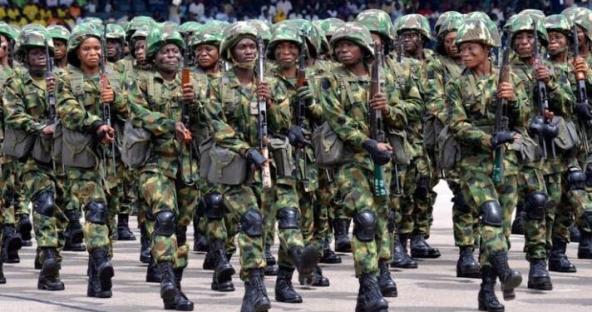
A security analyst, Ambassador Abdullahi Bakoji Adamu, has warned that continuous use of the Nigerian Armed Forces for internal security operations is weakening the Nigeria Police Force and posing long-term risks to the country’s democracy.
Adamu who is also a retired Army Captain, made this known in an exclusive interview with DAILY POST while reacting to recent comments by former Chief of Army Staff, Lt.-Gen. Tukur Buratai (rtd), who said the frequent deployment of the military for internal security duties is eroding the strength and effectiveness of the police and other civilian security agencies.
According to Adamu, the Nigerian Armed Forces are constitutionally designed for external defence, not routine internal policing.
“The military was created to defend the country from external threats, not to carry out day-to-day policing,” he said.
He explained that rising insecurity across the country including terrorism, banditry, mass kidnappings and communal violence has forced the government to increasingly deploy soldiers to perform duties traditionally handled by the police.
“Today, in many parts of Nigeria, the first security presence citizens see is soldiers, not police officers. Road patrols, checkpoints, raids and even arrests, which are core policing functions, are now commonly handled by the military,” Adamu noted.
The analyst said this growing reliance on soldiers shows that the military is gradually filling a vacuum created by weak civilian security institutions.
He warned that the situation comes with serious consequences, especially for the police.
“When soldiers constantly take the lead in internal security, the police stop developing the intelligence, investigative and community-policing skills required in a democratic system,” he said.
He added that this erodes the capacity and confidence of the Nigeria Police Force.
Adamu also raised concerns about the impact on civil liberties and human rights, stressing that soldiers and police officers are trained for different roles.
“Soldiers are trained for combat and end domination of threats, while police officers are trained for arrest, investigation and the protection of citizens’ rights. When these roles are mixed, accountability becomes blurred and civilian harm becomes more likely,” he warned.
He clarified that the situation is not the fault of the Armed Forces.
“This is not the fault of the military. They are responding to national emergencies. The real problem is delayed police reform and weak civilian security structures,” he said.
Adamu cautioned against an abrupt withdrawal of the military from internal security operations, saying such a move could be dangerous given the current security challenges.
“The solution is not to suddenly pull soldiers off the streets. That would create a security vacuum,” he said.
Instead, he called for urgent reforms in the police sector, including better funding, training and equipment.
“Nigeria needs urgent police reform, intelligence-led and community-based policing, and a clear framework where the military supports civil authorities only as a last resort,” he stated.
The analyst said Nigeria is not yet a military state but warned that continued dependence on soldiers for internal security is unhealthy for democracy.
“If the police force is fixed, the military will naturally return to its constitutional role. General Buratai’s statement should be seen as a warning signal, and Nigeria must act on it,” he said.