Table of Contents
New evidence has come to light that may clarify the longstanding hostilities between Fulani herdsmen and the residents of Agatu Local Government Area (LGA) in Benue State.
Documents exclusively acquired by DAILY POST reveal that a portion of Agatu land was covertly transferred to Fulani herders in 2017, a move that many believe has exacerbated ongoing violence and tension in the area.
For years, the communities in Agatu have been in conflict with herdsmen over grazing on agricultural lands.
This conflict has resulted in numerous fatalities, widespread displacement, and extensive destruction of farms, as reported.
Communities such as Aila, Okokolo, Obagaji, Adagbo, Akwu, Odugbehon, and Odejo, among others, have been severely impacted by the violence.
Residents from these affected communities have stated that their crops and livelihoods are constantly threatened, leading to repeated resistance against herder activities.
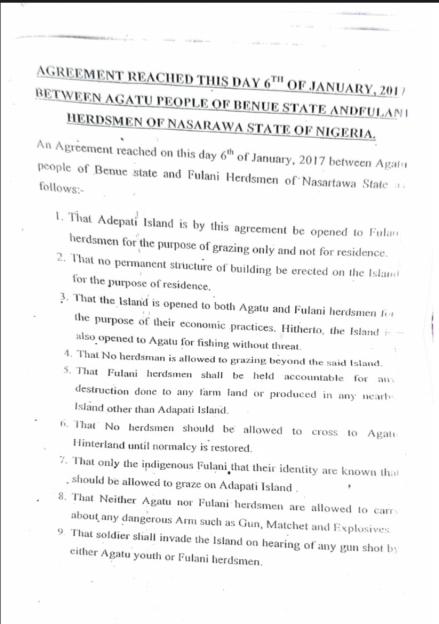


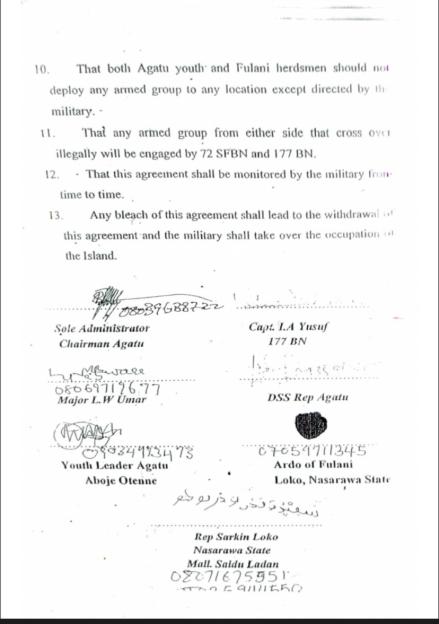
However, the newly revealed documents have uncovered a more complex issue: the 2017 cession of land in Adapati Island, which has been cited by both parties as a significant point of disagreement.
The agreement, dated January 6, 2017, was reportedly overseen by Capt. I.A. Yusuf, who was the Sole Administrator of Agatu LGA at the time.
Among its stipulations, the agreement stated: “Adapati Island would only be open for grazing, not for residence. Only 'indigenous Fulani' with verified identities would be permitted to graze on the island.”
Despite these conditions, the agreement has faced widespread criticism for being secretive and exclusive, lacking input from traditional leaders or the local community.
Chief Echechofu Ogwola, the clan head of the Ayele/Igagishu Clan, which governs Adapati land, has disavowed the agreement.
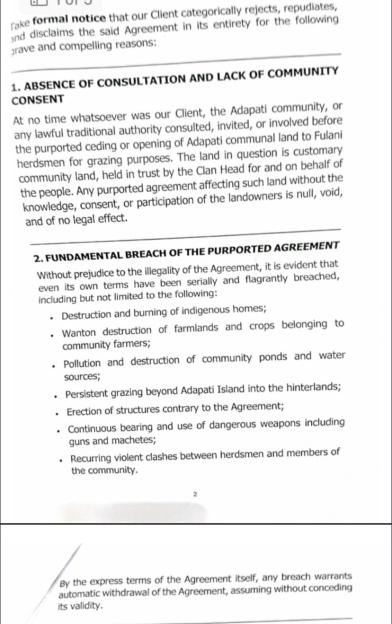
Represented by the law firm E-O Samson & Partners, the clan asserted that the land's cession occurred without consent, rendering it null and void under customary law.
They stated: “At no point were our Client, the Adapati community, or any legitimate traditional authority consulted, invited, or involved prior to the purported cession or opening of Adapati communal land to Fulani herdsmen for grazing.”
“The land in question is customary community land, held in trust by the Clan Head for the benefit of the people. Any agreement affecting such land without the knowledge, consent, or participation of the landowners is null, void, and without legal effect.”
The firm pointed out what it describes as repeated violations of the agreement, including: destruction of indigenous homes and farmlands; grazing beyond Adapati Island into other community lands; and the use of firearms and machetes, leading to violent confrontations.
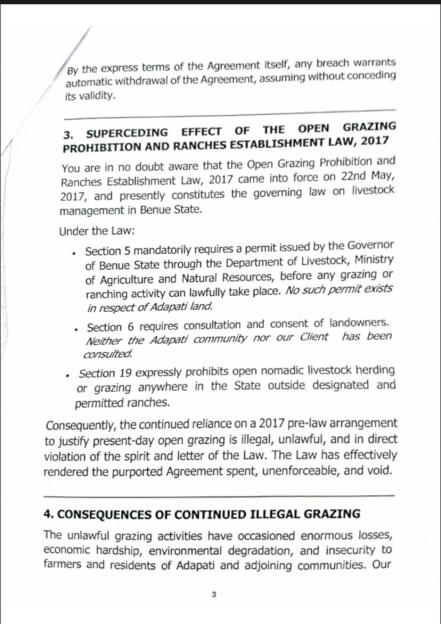
The situation is further complicated by the Benue State Open Grazing Prohibition and Ranches Establishment Law of 2017, which took effect on May 22, 2017.
Key provisions include: Section 5, which mandates a gubernatorial permit for grazing; none exists for Adapati.
Section 19 prohibits nomadic herding outside designated ranches.
The clan’s legal representatives have formally requested:
“The immediate invalidation of the January 6, 2017 agreement.
“The immediate cessation of all grazing activities and removal of herders, cattle, and illegal structures from Adapati land, with written confirmation of compliance within 30 days.
“The unlawful grazing activities have resulted in significant losses, economic hardship, environmental degradation, and insecurity for farmers and residents of Adapati and neighboring communities. Our Client and his community can no longer endure the continued infringement of their proprietary, possessory, and customary rights.”
“Failure to comply,” the firm warned, “will initiate legal action and petitions to state authorities.”
Previously, the chairman of Agatu, Melvin Ejeh, had granted herders access to Adapati Island and ordered all armed herders to vacate Agatu communities immediately.